Author: Roberta Grimes

Historical Revisionism

Christopher Columbus once ordered the simultaneous burning alive of a hundred Native American tribal leaders. The historian who mentioned this in a History Channel program awhile back tried to soften the shock of it by noting that “the fifteenth century was a barbaric age.”large_7730558908

There was a time when I would have shuddered and changed channels. Later on, I would have been comforted to know that people dying in pain are soon out of their bodies so their actual suffering is limited. Now, though, I hear about the burning of Native Americans by Christopher Columbus and I wonder whether it might be our fault.

The afterlife evidence tells us that reality is very different from what we perceive. Our senses and our prejudices lie to us, and we comfort ourselves by trusting a modern science that is equally senses-driven and prejudice-prone. In contravention of everything that mainstream science and your lying eyes tell you, here is what the afterlife evidence now tells us:

1)     Time is subjective, and it is not linear. If things are happening at all, then they are happening all at once.

2)    Matter and energy, time and space are holographic, which means that each unit (however you may measure it) contains all the information of every other unit.

3)     Matter and energy, time and space are mind-created. Universal Mind is their foundation, and each of us is an undivided snippet of that universal Mind. Another hologram. So our minds are more powerful than we can imagine.

4)    Mind-energy tremendously affects what we see as reality. Think of a horror movie in which when a hate-crazed actor arrives the castle starts to crumble, the peasants sicken, the grass withers and the skies cloud over. But then our loving hero comes back and that castle crisply reassembles itself, the peasants and grass recover, and the sun shines bright. Try to realize that this is something like the effect that our minds apparently have on our surroundings.

5)    All our lifetimes are happening simultaneously. Something like reincarnation does seem to happen, but it happens outside of time. More advanced beings tell us that as each of us makes or avoids making spiritual progress in this lifetime, we affect for good or ill all our other lives, past and future.

Please read this list again. Then multiply by every person on earth that insight that whatever we do in this lifetime affects every one of our past lives.

Temporarily trapped in this illusion as we are, we cannot really grasp what all of this means. But one thing that it may well mean is that we are not just the product of our history. We also may be the co-creators of it.

This puzzle has been on my mind for years, ever since I first began to wrestle with the time dilemma. The possibility that our modern evils are creating or worsening evils long past is both appalling and hard to grasp. But there seems to be no way out of it. The evidence is abundant, consistent, and incontrovertible to anyone with an open mind.

Imagine how all of this might be working. Stalin and Hitler, racial lynchings, and all the many evils of the twentieth century could have worsened the history that came before, created Biblical stonings and Medieval wars, perhaps turned Christopher Columbus’s capture of a few Native chieftains and sternly lecturing them into his burning one or two at the stake. And then ten.  And then a hundred. We would be none the wiser.

Now imagine that in this new century we begin to practice love and forgiveness within families, house to house, street to street, and then over all the earth. And gradually – imperceptibly at first – the world’s bloody history turns back to peaceful. Every book on every shelf in every library on earth records an ever gentler past, until all that evil never happened at all. 

It has long been thought that as modern humans migrated out of Africa, they conquered and destroyed the Neanderthal peoples that then inhabited what is now Europe. It turns out, though, that what they actually did was to assimilate Neanderthals as they moved north, so now everyone with European ancestry has Neanderthal genetic material.

18r5lc4ubwq1xjpg This wonderful picture was taken at the Neanderthal museum in Germany. It’s from a recent article that suggests that as much as 20% of the Neanderthal genome survives in modern humans.

It turns out that our earliest human ancestors made love, not war.

But somewhere along the way becoming “more civilized” seemed to be a good idea. We began the ongoing distortion of our own essentially loving natures that led erelong to the climactic evils of a cruel and bloody twentieth century. Now contemplate a hundred Native Americans screaming together as they burn, and the notion that their suffering could be the fruit of humankind’s later history. If you don’t want to learn to love and forgive perfectly for your own sake, then think about the possibility that you might be doing it for them.

It’s About Time

Part of the fun of doing afterlife research is the fact that as you put together many hundreds of afterlife communications received over nearly two centuries, you find that the dead are telling us remarkable things about the structure of reality itself.

The dead tell us that reality is energy-based. There is pretty strong evidence now that large_8382317948nothing is solid. As the great physicist, astronomer and mathematician Sir James Jeans once said, “The universe begins to look more like a great thought than a great machine.” All the levels of energy-based reality – including this one – exist in the same place, and they are separated from one another only by their different rates of vibration. So far, so good. The channels of your television set all exist in the same place as well, and that analogy makes it easier for us to imagine what actually happens at death. The dead tell us that when you die your mind will simply raise its own rate of vibration from this level of reality to the next, very much as you might change television channels, and there it will pick up a whole new solid reality! Dying is just that simple.

What seems to be even harder for most of us to grasp than the fact that there is no solid matter is the apparent fact that time and space also are subjective illusions. We are so dependent on the notion that space is spacious! In fact, with nothing beyond it, space is both infinite and tiny. Size is not one of its characteristics. We think it must be large because these temporary bodies that we believe we now occupy are infinitesimal in relation to it, but the dead tell us that they can travel instantly by mind across the entire universe.

And time is apparently also nothing like the arrow that we imagine it to be. Time is subjective, mind-created, and non-linear. As Albert Einstein said, “The only reason for time is so that everything doesn’t happen at once.” He also said, “The distinction between past, present and future is only a stubbornly persistent illusion.”

To further boggle your mind about time, I should add that there is considerable evidence that the following things are true:

1)    All our lives are happening at once. There is so much evidence that we live multiple lives that the concept of reincarnation cannot be denied by anyone who has examined the evidence, but rather than progressing from past to future, apparently all our lives are happening at the same time. Very rarely there will be moments of actual bleed-through from one of our lives to another. A very advanced being has suggested that the easiest way for us to understand reincarnation would be to imagine it as a bucket from which each lifetime is dipped and back into which each lifetime is poured.

2)    Future-life progression is as easy as is past-life regression. Dr. Brian Weiss pioneered techniques for hypnotically regressing people with phobias and other psychological problems to past lives in which some trauma had occurred, and he discovered that simply reliving that trauma could serve to cure the present-life psychological issue. Having been cured of a fear of heights this way, I can personally large_6827701945attest that his technique works well. Dr. Weiss then found that if there was no obvious source of problems in a past life, he could just as easily progress people under hypnosis to a future lifetime, and there he often found the causative trauma!
3)    History apparently is happening all at once. This is a natural corollary of the two previous points, and since time is not real it is probably inevitable. It may well be that all the aspects of what we think of as linear history actually are occurring simultaneously and intimately affecting one another.

So reality is not just stranger than we have been imagining it to be, but it is stranger than we can imagine it to be! Next week I will give you a boggling insight into what these facts about time might mean.

Tucson Festival of Books

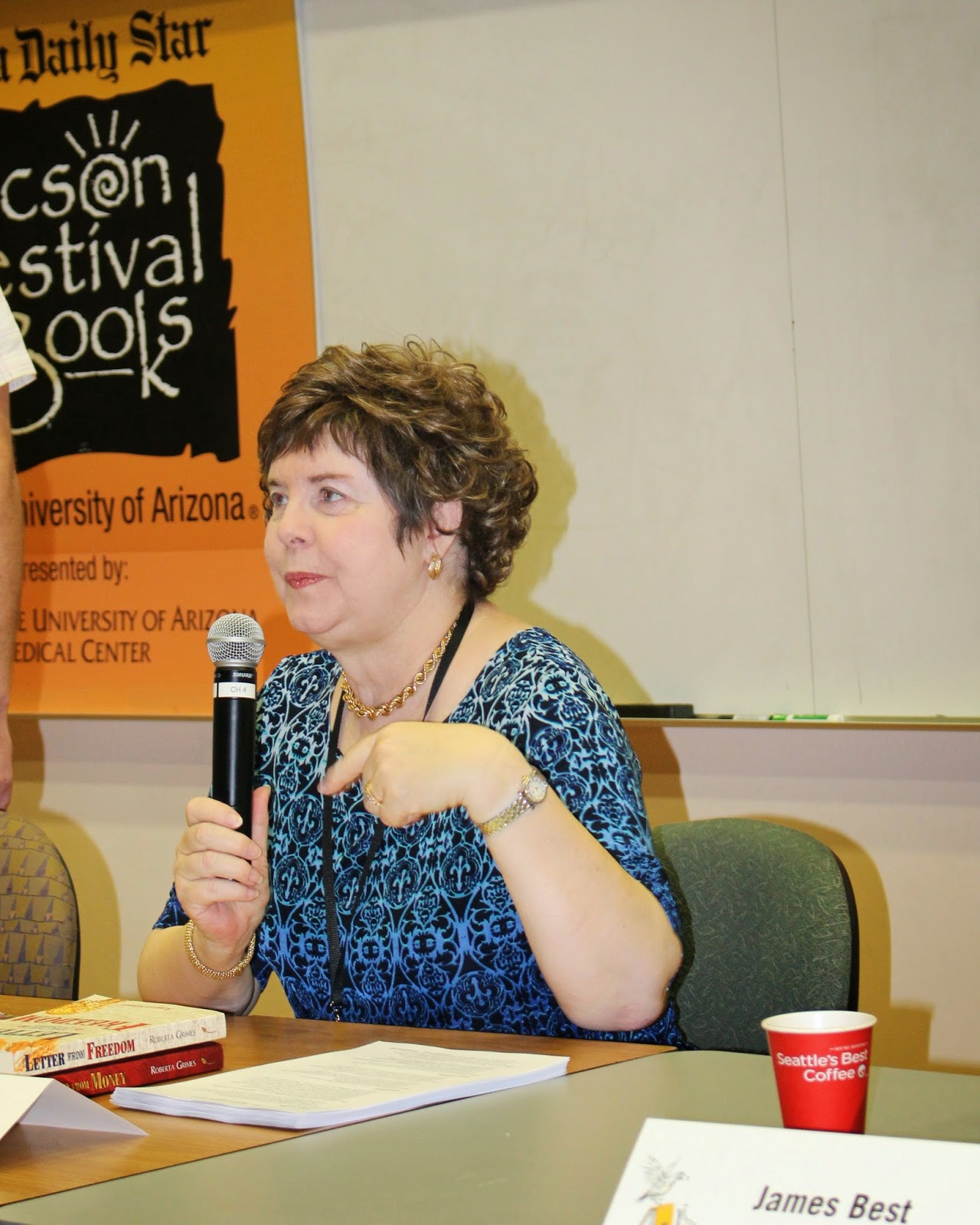
Thank you to everyone who attended the Tucson Festival of Books this past weekend, “Celebrating Books, Authors and the Power of Stories.” A lovely time was had by all!

It was my pleasure to participate in three panels in Tucson, including What Next? After Your Book is Published with fellow panelists Patricia Barey and Therese Burson.

My fellow panelists on a panel about independent publishing, pictured below, are James Best, the author of wonderful Western novels, and Santino J. Rivera, whose beautiful book is on the cutting edge of Latino culture. Our moderator was my dear friend, Grael Norton, from the hybrid publisher Wheatmark, with which I expect to do a total of six books in 2014.

My third panel presented aspiring authors with the choice of whether to try for New York legacy publishing, or whether to go with self-publishing or hybrid indie publishing. Since I have tried all three options at various times, I had a lot of information to share. While once it was an easy choice – go with a legacy publisher if you can, or otherwise go indie and hope a legacy publisher will eventually pick you up – the world is changing with amazing speed. And the fact that nowadays to sell a book to a New York publisher means that it can be maintained as an ebook by them forever so you will almost certainly never get back those rights makes the choice even tougher. Nearly all novels published by legacy publishers soon go out of print, and the author doesn’t even control the price of that forever ebook: I met someone in Tucson whose legacy-published book is now just an ebook priced at $40 and therefore never purchased. I have taken back and reissued two novels that were published by Berkley and by Doubleday twenty years ago, and it saddens me to think that young writers who gamble on New York today will probably never have that privilege.

But everyone I spoke with loved the Festival! What a joyous experience it was. By some estimates there were 140,000 people in attendance, and I feel as if I got to meet and enjoy at least half of them during two absolutely beautiful spring days in Tucson. Arizona may be hot in summer, but there is no weather on earth more perfect than a spring day in the desert!

In addition to providing two unforgettable days each year where words and imagination truly come to life, the Tucson Festival of Books also supports literacy programs in Tucson and Southern Arizona. Since its launch in 2009, the Festival has contributed $900,000 to local literacy programs.

The Tucson Festival of Books is already on my calendar again for next year. I hope to have the chance to meet you there!

When Scientists Had Open Minds

One of the things that astounds me as I continue to study the afterlife is that there is so much evidence of what is going on, it is so widely available and so consistent, it melds so perfectly with mainstream scientific discoveries, it helps to explain so much… but still nearly all scientists want nothing to do with it. And this odd stonewalling has gone on for more than a century.

The reason why scientists are so obsessively incurious about the evidence that exists for an afterlife large_4052593758and a greater reality seems to be based in the millennia-long war of ideas between science and Christianity. Both sides seem to have decided long ago that reality must have been either created by God in seven days exactly as the Bible suggests, or sprung from nothing as a clockwork automaton that had no spiritual component whatsoever. This is an ancient, epic battle to the death with just one possible victor, despite the fact that there has long been abundant evidence that neither side has it right. The battle continues even today in the debate over whether “intelligent design” can be taught in schools as an alternative to a rigid version of Darwinian evolution lacking any epigenetic complexities that not even most scientists support.

The sad result of this self-imposed scientific blindness is that an open-minded investigation of the implications of quantum physics and what actually is going on has been stalled for more than a hundred years.

But it wasn’t always this way. In the latter part of the nineteenth century there was a glorious period soon after the founding of the British Society for Psychical Research (SPR) in 1882 when the leading lights in the field of afterlife research and some of the world’s greatest scientists were open-mindedly sharing ideas. I have just come across a blog post that includes a wonderful letter from Max Planck that I simply must share.

            Knowledge is nothing to be feared. How is it possible that this nonsense still continues today? Fortunately, the field of afterlife research has acquired some scientific muscle of its own, and I am confident now that within our lifetimes this pointless battling between science and Christianity over positions that were long ago outmoded is going to end in breakthrough discoveries that will be impossible for anyone to ignore. Meanwhile, it is good to know that once there was a time when mainstream scientists had open minds.

Finding Angels

One of the best things about my adventures in afterlife research has been the extraordinary people I have met. There is a small group of brilliant folks worldwide who have devoted themselves to trying to understand death, the afterlife, and the nature of reality, and my joy since publishing The Fun of Dying medium_2260513414has been meeting and befriending many of them. Foremost among these wonderful new friends is the ebullient and irrepressible Gary E. Schwartz, Ph.D., of the University of Arizona, who is one of very few scientists actually researching the afterlife in a university setting. My favorite of his books is The Afterlife Experiments, in which he proves by means of double- and triple-blind testing that some psychic mediums actually are in contact with the dead, but I have read most of his work and it is all wonderful.



When last summer my family more or less demanded that I stop traveling to talk about The Fun of Dying, I began instead to do a weekly internet radio show on the Contact Talk Radio Network that we’ve called Seek Reality because that is what we do: each week I interview a different guest as we chip away at trying to understand what actually is going on. All my past shows are available as free podcasts, so if you’re curious please have a listen.

My guest last Saturday for the third time was my delightful and brilliant friend, Gary Schwartz. I so much enjoy just being with Gary that it took a listener to point out to me the fact that Gary had “unloaded a mini-nuclear bomb” on my program.

Gary was talking about a series of current experiments with detecting photons of light inside a pitch-dark chamber. He had been inviting certain specific nonphysical entities to enter it, including his friend Susy Smith and her friend, Harry, both of whom produced what amounted to their individual light-signatures. But then two others entered the chamber who identified themselves as “Gabriel” and “Sophia” and claimed to be angels. And, sure enough: the light detected in Gary’s experimental chamber when either of the angels was present was vastly greater than what could be produced by any entity who once had been in a body. OMG, as they say. I don’t actually even really believe in angels. Gary, too, had long been a skeptic. But unlike so many who claim to be scientists, he follows his experimental results where they lead, and he told me during our visit that reluctantly he had to admit that, yes, there were very powerful entities who were apparently angels.

Dear friends, we live in exciting times! Gary’s work with light is part of his overall effort to produce what amounts to a telephone that will let us converse freely with our dead loved ones. The work is pretty far along in several laboratories worldwide. And that the Archangels Gabriel and Sophia have chosen now to involve themselves suggests that the time for a soul phone really has come!

Listening to Imperator

Having mentioned William Stainton Moses last week, I can’t resist sharing with you some thoughts about Imperator, who was the leading spirit to communicate with Moses and the core author of an extraordinary nineteenth-century book called Spirit Teachings.

In general, the century from about 1840 until 1940 was a heyday of frequent, comprehensive, and often highly evidential communications from people who were ostensibly dead but actually were more alive than ever in a greater reality that is more or less exactly where we are. There are reasons why this flood of good communications happened then and didn’t continue past mid-century, some of which reasons relate to the communicators and some to the receivers. But the important thing is that there were brilliant and often skeptical researchers with impeccable backgrounds and little reason to want to fool us involved in many of these communication episodes, and much of their work has been preserved.

Despite the debunker nonsense that you will find on Wikipedia and other websites that are desperate to keep you from knowing the truth, William Stainton Moses was a breathtakingly accurate and honest nineteenth-century medium. A clergyman by profession, he had a special facility with automatic writing, and a group of advanced beings chose to communicate through him during the 1870s. Their book, Spirit Teachings, is astonishing!  What the dead had to say in the 1870s about the greater reality, human nature, the message of Jesus, and life after death is so breathtakingly consistent with the more recent afterlife evidence that I am repeatedly blown away by it. The odds against chance for such detailed agreement are so small as to make coincidence impossible.

For example, Imperator (the nom de plume of Moses’s primary communicator) tells us that:

1)     The message of Jesus is substantially correct, but He and His mission are badly misunderstood because human inventions and distortions have substantially corrupted mainstream Christianity.

2)    God is perfect love, and any teachings that portray God as wrathful, petty, judgmental, or otherwise showing any human failings are in error.

3)    There is plenty of human evil, but there is no personified devil.

4)    Our life is eternal and we can never die, not even if we wish to die.

5)    Earth-life is a school. Beyond death, we have the privilege of making infinite further progress.

… and so on and on, for page after page, saying nothing that is not entirely consistent with the Gospels and with all the later evidence.

Imperator was a “red-letter Christian,” as was Thomas Jefferson. He confirmed for us from a place where it was possible for him to know what is true that the original words of Jesus in the Gospels are truth. Much of the rest of Christian theology is based in the Old Testament and in the well-meant letters of Paul, so it is sadly off-track.

What the spirits share with us in Spirit Teachings is unsurprising to anyone who has studied our nearly two hundred years of abundant and consistent communications from the dead. No surprises. But to have already put the evidence together and then to find it all precisely repeated in the formal prose of a book that was printed nearly a hundred and thirty years ago is incredible to me. And it is beyond wonderful! Imperator insists that the truth of the message of Jesus will soon be widely known. And if it seemed “soon” to him back then, by now it must be immediate.  It cannot happen soon enough!

Skeptics and Debunkers

Anyone who has done much afterlife research has encountered the work of skeptics and debunkers. Honest skeptics have contributed tremendously to the advancement of our understanding, but sadly most of those who claim to be writing as skeptics are just debunkers. You cannot learn a thing from a debunker, so it will be important that you know the difference!

Honest Skeptics

Skepticism is a healthy approach to dealing with extraordinary claims. Some of the greatest afterlife researchers began their careers as honest skeptics. From Ian Stevenson and Raymond Moody through Bruce Lipton, Helen Wambach and Gary Schwartz to Elisabeth Kubler-Ross and Bob Monroe, most of the best afterlife researchers were startled to discover some seeming anomaly. They were curious, and with an open-minded skepticism they set out to study that anomaly enough to be able to explain it and move on. Of course, the phenomena that they had paused to study turned out not to be anomalies at all, so none of them ever did move on. Today their wonderful work forms the basis of modern afterlife-related scholarship. Others, of course, have studied some phenomenon, been unconvinced, and said so. But no honest skeptic ever will attempt to mess with the evidence, or will consider his own view to be determinative of anything.

Debunkers

Skepticism in researching the afterlife is a healthy thing. But many purported skeptics now dealing with afterlife-related evidence are not operating as honest skeptics at all. They are operating instead as debunkers. When they encounter an afterlife-related phenomenon, their first reaction is not curiosity, but fear. The most common debunkers are scientists whose materialism-based careers might be at risk if reality turns out to be more complicated than what mainstream science long has supposed. Many of them are atheists as well. For them, debunking afterlife-related phenomena is a two-fer: not only can they protect their careers, but they can maybe also give God the boot!

Debunkers try to pass for honest skeptics, and it can be hard to tell them apart until you have some experience. To help you recognize debunker foolishness when you see it, here are four common debunker techniques:

1) They might choose what they think is a key aspect of some afterlife-related phenomenon and try to reproduce it under laboratory conditions, thereby in their minds proving that no supernatural explanation is necessary. In doing this, of course, they ignore whole swathes of other aspects of these phenomena which could not be so easily explained! But since they can (for example) produce tunnel vision and visual spots of light by whirling people in centrifuges, the whole well-documented phenomenon of NDEs is thereby “debunked” in their view. Someone conceivably could have opened the film-box that was on the table at Scole while a session was underway, so all the extraordinary photographic evidence which instantly appeared there must be ignored. Whenever a purported skeptical researcher focuses on just one aspect of a phenomenon, that is your cue to be skeptical of him.

2) They speak and write as if scientific hypotheses are the final word on something. As any good professional scientist knows, all scientific claims remain hypotheses. If that were not the case, then how could basic scientific advancements occur? Since all scientific claims are working hypotheses which can be revised or rebutted in the face of new information, when some “skeptic” claims to have the final word, you know he is no scientist.

3) They deny that some well-documented event actually happened. If they cannot find a way to debunk something, they simply say that it has been debunked and move on. Don’t let anyone try to tell you that any afterlife-related phenomenon has been debunked until you yourself have impartially examined all the evidence.

4) They refuse to consider bodies of afterlife-related evidence as a whole. It is in the very nature of afterlife-related phenomena that the evidence for them is extraordinary and usually highly subjective. In general, these phenomena are difficult to study and usually impossible to reproduce. You were the only witness to the appearance of your mother at the foot of your bed while she was dying half a world away? Good luck getting anyone to believe that!

5) They selectively lie. A strong word, true. They specialize in negative propaganda in areas where their lying cannot be balanced, so to do an internet search on any so-called paranormal phenomenon is to decide before the fact that you are not interested in an open-minded search for the truth. To give just one example, William Stainton Moses was arguable among the greatest natural mediums who ever lived, but yet if you attempt a Google search on his name you will learn that he is a thoroughly discredited impostor. He is not that. Check out a blog post by the venerable Michael Tymn for a more balanced view.

To honestly research the afterlife is to begin an extraordinary voyage! When I started doing afterlife research, I assumed that most of the purported afterlife communications that I was setting out to read would be nonsense. What I was looking for was a few bits of similarities among some of them, hoping that I could use those bits to get some idea of whether in fact there was an afterlife and what that afterlife was like. But in reading many hundreds of communications from the dead received over nearly 200 years, I found no outliers whatsoever and I cannot recall finding one duplication. Sure, if you look at one afterlife communication, it might have been faked. But, hundreds? And they all perfectly agree? The odds against chance for such a finding are so long as to be nearly incalculable. Personally, I find this amazing result to be my own surest evidence that all of this is real. Debunkers, however, generally insist on dealing with each event individually.

Everything that a debunker says or writes is fear-based propaganda. Ignore it! Instead, concentrate on reading honest skeptics’ original research, and draw your own conclusions.

Is Civilization the Problem?

When it first occurred to me that civilization might be the problem rather than the solution, I chuckled at my own silliness. It was the 1970s. After having just lived through the turmoil of the sixties, I was feeling that we had gone-off track, and my little thought-experiment in living without the trappings of civilization that eventually became Letter From Freedom was going surprisingly well. But civilization is basic, isn’t it? For a long time, whenever it occurred to me that human nature is debased by civilization and not elevated by it, I slapped that idea away.large_12249032916

But now, more than thirty years later, I am back to writing about Atlantica again in a world that is in many ways even more debasing to humanity than was the world of the sixties.

On just one day a few weeks back, I read about Syrian gangsters playing soccer with fresh human heads; about people in Kalamazoo, Michigan, stepping around but otherwise ignoring a 31-year-old man who had been shot and was dying in the doorway of a store; and about the president of North Korea enjoying watching a political rival being eaten alive by starving dogs (sorry for that mental picture).

That day was my final epiphany. I’m sorry, but it’s time to say it aloud: TEN THOUSAND YEARS OF CIVILIZATION HAS NOT ADVANCED HUMANITY AT ALL.

           I defy you to show us any proof that statement is untrue.

             I have suspected since at least the mid-seventies that civilization had gone serious off-track, and no doubt you have had similar thoughts. It’s bad out there, and it’s getting worse. Still, what choice do we have? Wouldn’t a lack of civilization mean chaos?

I don’t have the answer, but I think it is long past time for us to ask the question.  

What is civilization? I’m going to define it here as the organizing systems of governments and religions. If you have a better definition, please share it in the comments, but for this brief medium_3989138122discussion let’s try out mine. Down through all their history, governments and religions have had certain things in common:

1)    They define human beings as flawed and base. Animalistic. Fallen from grace. Unable to live in natural harmony with one another.

2)    They define themselves as essential in order for human beings to live peacefully together. Both governments and religions see their roles as controlling what are natural human tendencies toward evil and chaos.

3)    They operate by coercion. Whether it’s civil laws or religious rules, the very essence of civilization is restraint.

4)    They require that some people exercise power over others. The only difference between governments, whether civil or religious, is the extent to which they will accept restraints on their own powers. A republic is more pleasant than a dictatorship, but it is a difference in degree and not in kind.

5)    They tend toward ever greater controls and corruption. From the treasure of kings and popes to the bureaucratic cronyism of modern governments, all civil and religious systems tend to aggregate ever more power to themselves, and to confiscate ever more wealth that they had no part in producing.

            Given these universal characteristics of civilization, the only reason to continue to allow governments and religions to operate at all would be if they were essential in order for human beings to live together.large_4689090638

            Do we need them? That’s the real question, isn’t it?

I have spent decades reading nearly two hundred years of abundant and consistent communications from the dead. The amazing fact that many hundreds of such communications are entirely consistent with one another helps to prove to us that the afterlife exists. The further fact that the afterlife they describe is entirely consistent with the core science of quantum physics is of course astounding. There is a world of truth waiting to be investigated as soon as mainstream science stops fighting it.

Of course, the afterlife evidence has a lot to tell us about the afterlife itself. The fact that it also explains a great deal about reality in general is a wonderful bonus. But for me, the best thing about the afterlife evidence is what it has to tell us about human nature. The afterlife evidence tells us with absolute consistency that our minds are part of eternal Mind, which is the only thing that exists. Our minds are part of God, in other words. Therefore, in truth, we are all good. 

Oh. So both governments and religions are making precisely the wrong assumptions medium_2767020490about human nature. In doing so, they are imposing on us laws and restraints that are probably unnecessary, and that distort our true nature in ways that create problems rather than solving problems. I think this is a fact, based upon the evidence. And further proof of its truth is the certainty that after more than ten thousand years of trying, governments and religions have done nothing whatsoever to make people better in any way. Nothing. Nada. Rien.

But if civilization doesn’t work at all in advancing human nature, then what might work? That is the question that the Letters From Love Series is designed to ask, and to begin to answer. Stay tuned!

Signs From the Dead

Our growing understanding of how reality is structured makes us realize how near the dead are to us. They are right here! We’re told that there are something like eight primary levels of energy-based reality, separated from one another by their rates of vibration, and all of them are exactly where we are. But far from making communication easier, the fact that reality is an energy spectrum all located in a single place makes unaided communication from there to here seem impossible. Think of your Channel Five weatherman and your Channel Seven newsman trying to chat with one another while both are on air, and without a phone. The fact that communication between Knuckles Range - Rusticlevels through mediums has become a well-documented phenomenon is a wonder! But what if we never consult a medium? How else can our loved ones signal their survival?

It seems that over the millennia the dead have wrestled with this problem. They are more aware of us than we are of them, and as they transition and adjust to their new surroundings they are anxious to get word to us that they are still here. We are coming to understand that even long before there were earth-based scientists, there were clever and dedicated teams of dead researchers trying to understand what they were dealing with and puzzling out how to deliver signs to us that they lived on.

It is from this perspective of ancient experimentation that we must look at the kinds of signs that come to us from those we love in the period soon after their deaths. Many are natural objects like feathers and stones, or growing things like flowers or insects; and some involve what seems to be the manipulation of the minds of animals and people. Some of the objects – and even the insects – are likely apports. They are objects materialized from there to here, in a process never studied and not well understood. There are hints that apports may be removed from this material level at some other point in time and deposited back here, often materializing in air, so a decades-old newspaper (for example) could plop onto a table looking fresh from the press.

So, what are some of the physical signs that our dead loved ones can send to us soon after their deaths?

1) Coins. People start finding coins in the same denomination – pennies mostly – or they find clusters of large_8587989414the same set of coins. The coins sent as signs will sometimes bear a significant date, such as a birth or death year or a wedding year.
2) Feathers. Some of the dead have made feathers their specialty. Of course, finding a feather loose beside your feather pillow isn’t going to mean much. But repeatedly finding feathers of all kinds on the ground, in drawers, even in your pocket can mean that someone you love is thinking of you.

3) Dragonflies and Butterflies. Beautiful insects are such a common sign. It may be that bees and ants also are used, but nobody takes much notice of them; however, a big dragonfly that comes to sit on your hand or a butterfly that dances in front of you is hard to miss. One spectacular insect sign happened soon after a teacher’s death. Her replacement reported that on the first school morning after her death, a yellow butterfly flew in through an open window and went up and down the rows, lighting briefly on the head of each wondering child, and then flitted out again.

Common Picturewing4) Electrical Manipulation. You can imagine the joy in heaven when we started electrifying our homes! Since our beloved dead are energy beings, messing with electricity is easy for them, and just within the past century or so they have learned to do it very well. They blink lights, turn televisions on and off, and even sometimes put messages on computer screens. They can extinguish streetlights as we pass beneath them, cause cellphones to ring, and even (rarely) dial us up to have a chat.

5) Scents. Whiffs of cigarette smoke or perfume or perhaps the smell of lilacs or cooking: the dead seem to be surprisingly able to make us experience familiar scents. As someone who has enjoyed this phenomenon – my first scent communication, long ago, was of my grandmother’s perfume – I have wondered whether the scent is out there in the room. Could others standing nearby smell it, too? I have come to think not. I have come to believe that the dead are able to impress the scent directly on our minds, but whether that is true is anyone’s guess.

6) Physical Impressions. This kind of sign seems to be less common, but some of the dead will create phenomena which make it seem as if they are physically present. A surviving spouse might feel and see the other side of the mattress compress, or a spouse or parent might feel a physical hug. Someone who lost a beloved pet might feel and see the indenting of the coverlet by his feet, and then a depression where that pet always slept.

7) Visualizations. Sometimes, near the moment of someone’s death, he or she will appear to a loved one many miles away. Generally these apparitions will look younger and happy, they glow, they don’t speak, and often they are just bust-high or waist-high.

 8) Birds and Small Animals. The most common small-creature signs are birds swooping in front of our windshields. Or sometimes a type of bird will be reported far outside its range, like the Florida crane that graced a Long Island gravesite several days in a row. Freakishly unafraid squirrels that have large_3719756211approached and seemed to know us have been reported, too. There was one summer afternoon a couple of years ago when a huge owl came and perched on a light while a celebration of someone’s life was underway on a patio below it, and it stayed there until the last guest left. Our loved ones might be impressing their own minds onto the minds of these creatures to make them behave this way, although no one knows for sure.

9) Numbers. Seeing on a digital clock or a license plate a series of the same number repeated, or perhaps a date or other number that would be meaningful such as a birth, wedding, or death date, can be a sign from a deal loved one. Just one such instance isn’t meaningful, but if you repeatedly see a number like 11:11 when you randomly glance at a digital clock, your loved one may be reaching out to you.

10) Coincidences. We have had communications from upper-level beings who insist that there are no coincidences, and every seeming coincidence is the work of Spirit. I don’t know about that. But I do know that the chances that some of the stranger coincidences we see could occur at random are less than we suppose, so it is important to pay attention. When my mother died, someone sent me calla lilies, never realizing the importance that particular flower had in my mother’s life; and someone else sent a sympathy card that featured chickadees (Mother’s favorite bird) perched in lilacs (Mother’s favorite flower) oddly out of season. I assume that those were signs from my mother, but I won’t know for sure until I contact a medium.

11) License Plates. To be thinking of a loved one and at the same time see a license plate with his name or with some other significant term on it really brings you up short! Yet it happens. We have no idea how the dead are able to pull this off.

12) Songs. Here is something else in the category of: We have no idea how they do it. But they do. And often. A widow of someone recently dead will turn on a car radio or enter a store, and there will be playing the very song that the couple danced to at their wedding.

Don’t assume that everything that happens is a sign, but pay attention in the months after a loved one’s death. When you spot a possible sign, be sure to thank your loved one, since if the dead think they are being ignored they will generally give up.

How do we know that the dead send these signs? Because they tell us, over and over again. We are told that there are teams which help the newly dead to orient themselves to their new lives, and one of the things they offer to do is to teach new arrivals how to produce signs for their loved ones. Some of the dead become good at it, and a few are still delivering signs decades later. But for most of the dead, signs are given within the first year or two after their deaths, and once they see that we are past the worst of our grief they generally abandon the practice. They know that we’re fine. And they have lots to do!

It’s impossible to know what percentage of the dead will give us signs of their survival, but my research has led me to think that most of them try. They remain the same people after they die, and their love for us is as intense as it ever was. So, keep your eyes and your heart open!

Thomas Jefferson and Slavery

Cultural realities shape our lives in ways that become so ingrained that we often don’t see evils for the evils they are. When you and I look around, we can see lots of things about Thomas Jeffersonpresent-day America that are likely to appall our descendants, from overstuffed prisons and third-trimester abortions to vast disparities in wealth and station and the careless ways in which we inflict adult entertainment on our children. The fact that you and I don’t become personally involved in any of these practices doesn’t let us off the hook, since if enough of us protested, things would change.

Thomas and Martha Jefferson were born into a world in which the slavery of peoples brought here from Africa had been part of their culture for a century. It was a normal evil, just as the things mentioned above are evils that seem normal to us. Having been born near the pinnacle of a society in which slavery was a fact of life, both Thomas Jefferson and Martha Wayles Skelton Jefferson inherited human beings.

They were stuck with slavery. As Jefferson said later in life, they had a wolf by the ear: they could neither hold onto it nor safely let it go. And being freed was not an attractive option for a slave in Eighteenth-Century Virginia. It was legal at that time for anyone who encountered a freed former slave to enslave him again; and even beyond Virginia, freedmen lived wretched lives on the margins of white society. Discovering that Jefferson felt stuck with slavery as an institution that he detested was an important step for me, since I don’t think I could have written My Thomas if the truth were otherwise.

From my brief study of it, slavery in Eighteenth-Century Virginia seems surprising in a number of ways:

1)    Apparently sexual relations between the races didn’t much occur before the middle of that century, so during Jefferson’s youth nearly all the slaves were of exclusively African ancestry.

2)    Slaves apparently worked until dusk six days per week, but then typically had Sundays off. In Jefferson’s case, there is evidence that he often used Saturdays off as a reward.

large_98791152043)    During their free time, Jefferson’s slaves raised vegetables and chickens for themselves, and they sold their surplus food to their master for money. I know… I didn’t believe it either, but Jefferson’s written accounts of some of these transactions still survive.

4)    Jefferson was set emphatically against the physical punishment of his slaves. His attitude seemed to be that he and they were stuck with this situation, so his only option was to care for them and treat them fairly. I was able to find just one instance of his ordering the whipping of a slave, and that was in his old age when apparently a teenager drove him temporarily insane. This incident upset him so much that it may have been the exception that proves the rule.

Martha Jefferson spent most of her life in the friendship of Betty Hemings, the half-white slave her father took to his bed soon after his third wife died. At his death, Martha inherited Betty and her children, six of whom were Martha’s half-siblings.

Thomas and Martha seem to have treated the Hemingses almost as part of their family. The love ran deep, and this difficult situation may have been one reason why Thomas Jefferson’s contemporary writings indicate an increasing impatience with slavery as an institution. He was too clear-headed and practical to think the problem would be easy to solve, but during large_1401417032Martha’s lifetime he seems to have become increasingly determined to solve it. His first step was to engineer a ban on the importation of African slaves, and thanks to his efforts, in 1778 Virginia became the first place on earth to ban the importation of slaves.

In 1781 Thomas Jefferson retired from politics altogether. Had Martha lived, he would have had the time to pursue the experiments in racial understanding and integration that were by then foremost in his mind. With his extensive political experience and skill, there is a reasonable chance that he would have been able to manage an end to slavery in America long before the Civil War. But when Thomas lost Martha, he seems to have lost his race-relations motor. He fled Virginia and the future they had planned together, and he tried to fill the void she had left by resuming his political career. It’s too bad, really. It’s difficult to read his Revolutionary-era writings on the subjects of slavery and race and not think about what might have been.