Author: Roberta Grimes

Consciousness Dawns

O Lord my God, When I in awesome wonder
Consider all the works Thy hands have made;
I see the stars, I hear the rolling thunder,
Thy pow’r throughout The universe displayed!
Chorus Then sings my soul, My Savior God, to Thee;
How great Thou art, How great Thou art!
Then sings my soul, My Savior God, to Thee;
How great Thou art, How great Thou art! 

When thru the woods And forest glades I wander,
And hear the birds Sing sweetly in the trees;
When I look down From lofty mountain grandeur
And hear the brook, And feel the gentle breeze,
Chorus Then sings my soul, My Savior God, to Thee;
How great Thou art, How great Thou art!
Then sings my soul, My Savior God, to Thee;
How great Thou art, How great Thou art!
– Carl Boberg (1859-1940) & Stuart K. Hine (1899-1989), from “How Great Thou Art” (1885; 1949)

Yet another year comes to its close, and it marks for us a full century and a quarter since the mainstream scientific gatekeepers imposed upon all scientific research its mandated dogma of materialism. Those gatekeepers thereby turned mainstream science from what should have been an open-minded pursuit of the truth into what still amounts to the closed-minded religion of atheism. Only think of it! At the start of the twentieth century, those leaders then controlling the university science departments and the peer-reviewed scientific journals were so alarmed by the budding implications that they saw in the field of quantum mechanics that they informally, but still firmly, imposed a dogma of materialism upon all scientific research. And, what were they so afraid of, pray tell? Simple. They feared that quantum physicists were much too close to actually finding – or at least claiming to find – the genuine God. It is likely that this restrictive dogma was expected at first to be temporary, and held in place just until those gatekeepers could better understand all the implications of quantum mechanics. But early decades soon stretched into years upon years….

A full century and a quarter for mainstream scientists to have been laboring under such a restrictive dogma has become, at this point, a very long time. And for many years, as we have done our occasional check-ins, we have seen very little scientific progress made in some fields as a result. That materialist dogma has not been much of an inconvenience in certain areas of investigative science, so during the twentieth century and into the twenty-first there has indeed been considerable research progress made in the core scientific disciplines of traditional physics, biology, medicine, and of course in materialist areas like geology and chemistry. But where meaningful progress glaringly has not been much made has been in some few very significant fields! And three areas in particular have been deeply stunted:

  • Consciousness. What consciousness actually is, where and how it is generated, what it does, how it works, and so on endlessly: materialist science simply has no clue at all about consciousness, even to this day. For example, more than a billion dollars has been spent in seeking a source of consciousness inside the human brain, only to always come up empty. Mainly, it seems that mainstream scientific efforts in the fields of consciousness research have been focused on proving that consciousness is surely not-God! Some 125 years after the mainstream scientific gatekeepers first imposed materialism on mainstream scientific research as their fundamental scientific dogma, they still understand close to nothing about what consciousness is, nor what it does, nor even where it comes from.
  • How Life Began on Earth. The basic mainstream scientific story about how life began on earth that is almost universally presented in textbooks has lightning hitting just the right mix of chemicals in a pool of water, and Zap! Life happened. Life was just single living cells at first, but gradually those living cells became more complicated, and they combined into multi-cellular creatures, which then eventually became animals. But of course, this explanation makes no sense at all. For one thing, such suddenly-alive single bits – sure, call them cells – would have no way to remain alive beyond the briefest moment; and they would lack any way to add what they would need to add as the basic means for maintaining their lives beyond that first instant. Nor would they have any way to eventually combine with other also suddenly-living cells, and nor would they be able to ever replicate themselves. The theory as it is presented in textbooks never has a way to take us much beyond that first living instant. To this day, textbooks authoritatively say that this is the way that life began on earth, even though there still is no real evidence that anything like this ever happened.
  • How Evolution Actually Works. The story of evolution as it usually is told is that very simple, even single-celled organisms gradually evolved into ever more complex organisms over eons of time, with the fittest surviving, endlessly changing form and growing ever larger and more complex in endlessly creative and ever more positive ways; and smoothly developing new features and functions, but entirely without any overall plan, and without the need for prompts from any designer. This broad evolutionary tale that is generally told quite frankly boggles the mind. How is it, for example, that a functioning mega-dinosaur smoothly evolved over time from some single-celled creature, without any plan in place for that to happen? Or for that matter, how did gazelles evolve, again with no plan? How did totally random evolution ever bring us sentient humankind? Of course, the frank evolutionary record tells us that what really happened instead of this imagined, utterly random evolutionary track was even weirder: it was long periods of stasis in nearly all animal lines, where little or no change happened; then those periods of stasis were generally followed by sudden, brief periods of rapid change to a new, entirely different creature, which then in turn would go on for a long period of stasis living as that new creature, again with very little change. Scientists who study evolution call this phenomenon “punctuated equilibrium”. In fact, something like punctuated equilibrium indeed does happen in some lines; but all the explanations for it, and the reasons why it doesn’t seem to happen more often, still are poorly understood.

For mainstream scientists to come to fully understand these three important aspects of reality, whether we take each of the three individually or we choose to see all three together, will be tremendously important! For us to fully understand everything about consciousness; about how life began, and about how life developed and became stable from those earliest sparks; for us to come to finally see how evolution truly works in detail, all of this is basic stuff. And yet, the horrifying fact that we confront yet again at the end of the year 2025 is that traditional materialist scientists still understand  almost nothing about consciousness. They still don’t know how life got started on earth, and nor how it developed from there. And their understanding of how evolution works is still very primitive, at best, when their materialist dogma will never allow them to admit to any kind of a designed process, nor to seek the source of any sort of evolutionary plan. The plain fact is that, even though these questions lie at the core of our ever understanding how our reality works, materialist scientists don’t yet understand any of these three phenomena, pretty much at all, even more than a hundred years after they first imposed their dogma of materialism upon all of mainstream science. And this appalling level of ignorance is a much bigger problem for the whole scientific community than that community ever has let on.  

So, now we look again quickly as the old year ends at our favorite popular science magazines’ latest issues, to see whether there might at this point be even a hint of progress toward greater knowledge to be spotted anywhere.  And, yes indeed, there is! The Discovery Institute’s Center for Science and Culture in Seattle, Washington,  has been around for about thirty years now, and it does phenomenal work in the field of non-dogma-based, truly open-minded scientific research. From them, we learn that the argument over intelligent design is by no means seen as settled. Evolution is being studied and debated, and a synthesis among competing theories is at length being sought. What is wonderful is how much more open-minded all of science really seems to be becoming now, thanks to the work of these intellectual leaders!

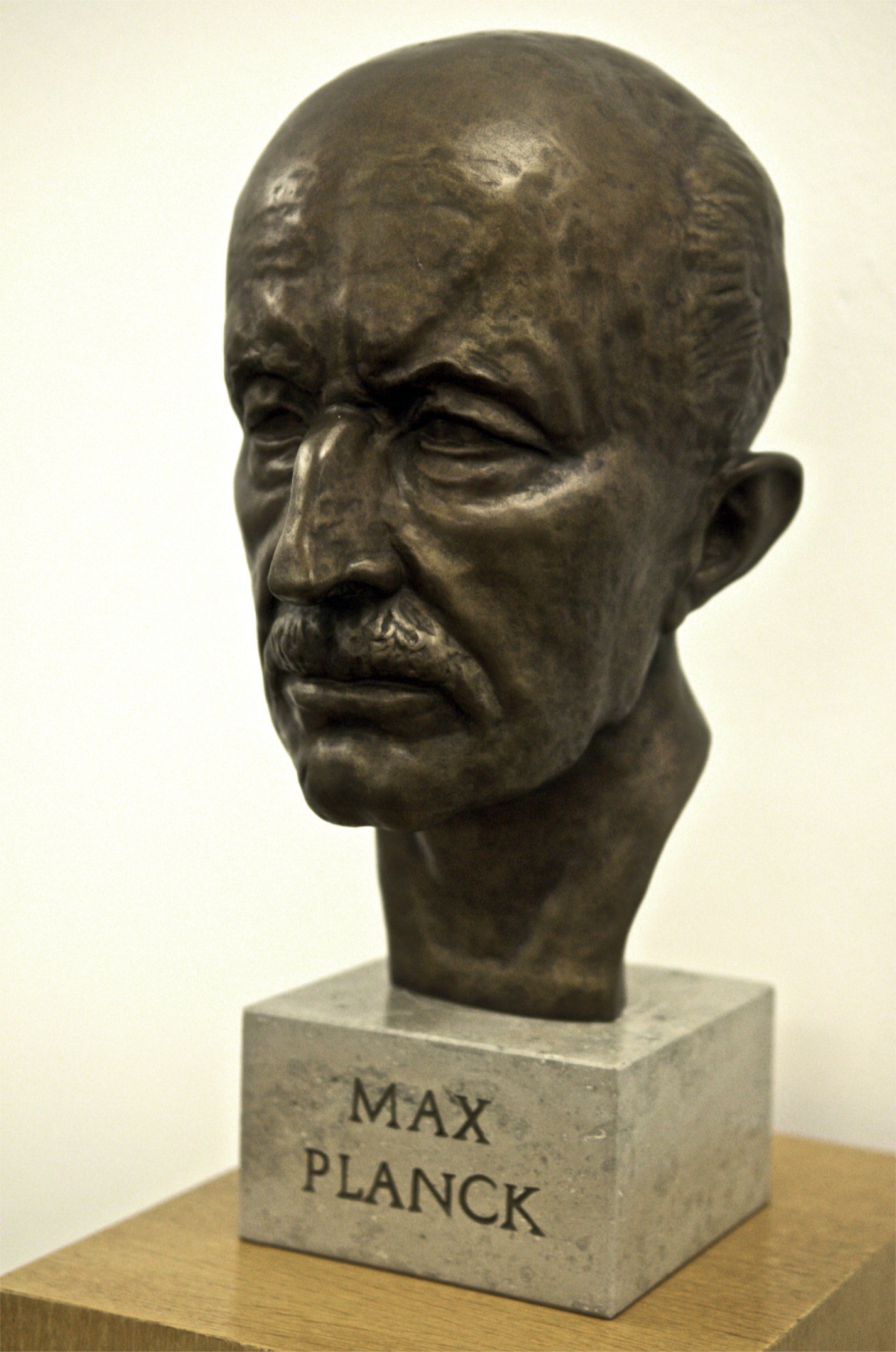
And, wonder of wonders, now at last we are seeing a first, dawning awareness among trained scientists of something that Max Planck, the father of quantum mechanics, already fully understood more than a century ago. Dr. Planck saw way back then that consciousness is basic, and he could see that there is no way to get behind consciousness. In 1931 he said, “I regard consciousness as fundamental. I regard matter as derivative from consciousness. We cannot get behind consciousness! Everything that we talk about, everything that we regard as existing, postulates consciousness.”  And indeed, even we lay researchers have long since come to the same, basic and inescapable conclusion. Consciousness is all there is, and the grounding of all reality. Consciousness is where each of us lives and moves and has our being. Consciousness is the sculptor as well as the clay. Consciousness is nothing bt God’s perfect love, and my dear ones, there truly is nothing else!

Even back a century ago, Max Planck felt strongly that consciousness had to be basic, and it must underlie everything. And, sure enough, scientific research has been inching in that direction ever since;  until now, when what is precisely Max Planck’s concept of consciousness underlying it all is actually, finally, being proposed scientifically. So, my beloveds, is that newly-discovered consciousness layer actually God for real, lovingly underlying for us all of reality?  When my dear Thomas tells us that is just what scientists at last have found, and he chuckles at the follies of humankind, then we all have to smile with him! My dear ones, the truth can indeed be kept from people, even sometimes for a century or more; but, the truth cannot be hidden forever. Always sooner or later, the truth will win.

When Christ shall come,
With shout of acclamation, And take me home,
What joy shall fill my heart!
Then I shall bow, In humble adoration,
And there proclaim, My God, how great Thou art!
Chorus Then sings my soul, My Savior God, to Thee;
How great Thou art, How great Thou art!
Then sings my soul, My Savior God, to Thee;
How great Thou art, How great Thou art!
Carl Boberg (1859-1940) & Stuart K. Hine (1899-1989), from “How Great Thou Art” (1885; 1949


(Many photos are from Vecteezy.com)


What Does He Mean?

Day by day, Day by day,
Oh Dear Lord, Three things I pray.
To see thee more clearly, Love thee more dearly,
Follow thee more nearly, Day by day.
 

Oh… Day by day, Day by day,
Oh Dear Lord, Three things I pray.
To see thee more clearly, Love thee more dearly,
Follow thee more nearly, Day by day.
 

Day by day, Day by day,
Oh Dear Lord, Three things I pray.
To see thee more clearly, Love thee more dearly,
Follow thee more nearly, Day by day.
— Stephen Schwartz, from “Day by Day,” from “Godspell” (1971)

For my whole life, I have struggled to ever better comprehend what Jesus actually meant by all the things that He said during the three and a half years when He taught on earth two thousand years ago. Almost as soon as I was able to read such sophisticated language as is in the Bible, I was attempting to read the four Biblical Gospels in a little copy of just the Gospels that some Mormon visitor had given to each of the children in my Congregational Church’s Sunday School. And even as a young child, almost every time that I attempted to read those Gospel words, I seemed to be finding new shades of meanings in what Jesus was saying there to us. So to deepen my perspective, by the age of eleven I had graduated to reading the whole Bible through, from Genesis right through Revelation, just a couple of pages every night. I wanted to see what added perspective all the rest of the Bible might add to what Jesus was saying there in just His four Books. And then of course I went on to major in early Christian history in college.

One of the things that I learned in college was that if I hoped to understand my treasured Jesus’s deepest thoughts, I would have to deal with some additional complications. For one example, Jesus spoke Aramaic while He was on earth, but His teachings were first written down in ancient Greek some sixty or so years after His resurrection. So there would be His first translation. And later on, of course, would come a second translation from Greek into Latin in the early Middle Ages. Then after additional centuries had passed would come yet more translations, into English and into other modern languages. And with each translation, additional fallible human translators had to make decisions which sometimes did at least some level of violence to what Jesus originally had said in the lyrical and emotional language that was His original Aramaic. The classic example often used to illustrate this problem is the ancient Greek word “Metanoia”. What Jesus almost certainly first said in Aramaic, which then was translated into Greek as “Metanoia”, was “transform your mind.” But the early Medieval Christian monk who first saw that word “Metanoia” in Greek is known to have translated it into the Latin command that we must “repent”. And that is how the insistence that we must “repent!” ended up as a command from Jesus throughout the first Latin translations of His spoken words. Even though it surely was nothing that Jesus ever said, or indeed that He ever would have said!

But remember that by the Middle Ages, that monk who was Jesus’s first translator from the Greek into Latin was a member of the Roman Emperor Constantine’s fear-based Christian religion, which is the Christianity that still prevails in the world today. That monk never knew the genuine Jesus, nor did he have any idea of what the genuine Jesus actually had taught. And the Christian religion of that Medieval monk who was privileged to translate the words of Jesus was built not around love, of course, but instead his Christianity was centered on the ancient Hebrew religious idea that Jesus had come to die as a pure sin-sacrifice to redeem us from God’s judgment for our sins. Jesus had been a sin-sacrifice without blemish. That whole pure sin-sacrifice idea had been a concept central to the religion of the ancient Hebrews, and well known to the Apostle Paul. It was familiar as well to the Councilors at the Council of Nicaea who had created Constantine’s Christian religion. The monk who created that translation therefore readily believed that the Jesus he was sure must have founded the Christianity that he so devoutly followed very much later on would of course have ordered us all to “repent”!

But Jesus was not the founder of what eventually became modern Christianity. What Jesus Himself created was “The Way,” which was the beautiful and simple love-based spiritual way of life that He taught to His disciples. The Way then grew rapidly for the first two hundred years after Jesus’s death and resurrection, all around the Mediterranean Sea until it had amassed millions of followers as far away as Rome. And our great tragedy as we try to more deeply understand the true Jesus now is the inexorable fact that human history is written by its winners. The Romans decided that they could use The Way, but not in its original form. So they ruthlessly persecuted it, and they crushed it and nearly wiped it out. By the early 300s, there was almost nothing left of Jesus’s original Way but its scriptures, which still had the name of Jesus attached to them when Constantine resurrected The Way in 312, and it then was formalized as Roman Christianity at the First Council of Nicaea in the year 325 CE. By then, The Way had allowed all sorts of spiritual side-theories and dogmas to develop; and in order for it to be useful to Rome, Constantine’s version of Christianity needed to be transformed from a spiritual movement and way of life into a fear-based religion that would make it an efficient means of mass human control. Nicaea’s formal version of Christianity was therefore built around a lesser dogma that had developed within The Way, which was that Jesus’s death on the cross had been a sin- offering required by God to cleanse us of our sins.

Still, the core of Jesus’s teachings when He was on earth had not been focused on sin. And the Councilors who were creating this new religion of Christianity under Constantine’s direction, and were assembling their new religion’s sacred Book, held a sufficient reverence for the teachings of Jesus that fortunately they left nearly all of His teachings just as they had received them, and they put what they added in the course of building their new religion just at the back of each of their chosen four of the many accounts of Jesus’s words that were then in circulation. Thomas tells me now that He and some of Jesus’s other followers not then in bodies were influencing the minds of many of the Councilors at First Nicaea, and at the six other first millennium councils. So they were able to shape to a considerable extent what happened at all of those councils, especially with regard to the selection and preservation of those four Biblical Gospels.

The way that the Christian Bible was assembled at First Nicaea with what we now know was spiritual guidance, and then carefully preserved thereafter, allowed the precious words of Jesus to be largely preserved. Yes, there are some contradictions within the Gospels themselves as to what we are told that Jesus said, but those contradictions come largely from translation concerns, from Christian dogma-based contradictions, from some First Nicaea Councilors’ additions, and from the frank fact that as they invented their religion, the Councilors never thought to check to see whether they were going directly against any of the spoken teachings of Jesus, the Prophet that they were claiming as their nominal founder. Here are examples of each of these problems

  • Translation Concerns. Some older Biblical translations still show Jesus calling on us to “Repent,” when what He really said was that we should “Reform or renew our minds.” Modern English translations are generally freer of this kind of distortion.
  • Jesus had to speak circumspectly because He was often speaking directly against the prevailing religion. And in fact, Jesus came to free us from all religious restrictions! It is important to keep these facts in mind. For example, since the prevailing Hebrew religion when and where Jesus taught on earth was largely focused on sin, and perhaps we might even say that it was in some ways obsessed with sin, Jesus often has to responds to the issue of sin, although in His own teachings, Jesus never focuses on sin. Instead, His teachings focus on love and forgiveness. That is a crucial distinction! Jesus is often quite casual about disregarding sins. For example, consider this passage: “At that time Jesus went through the grain fields on the Sabbath, and His disciples became hungry and began to pick the heads of grain and eat.But when the Pharisees saw this, they said to Him, ‘Look, Your disciples do what is not lawful to do on a Sabbath.’ But He said to them, ‘Have you not read what David did when he became hungry, he and his companions, how he entered the house of God, and they ate the consecrated bread, which was not lawful for him to eat nor for those with him, but for the priests alone? Or have you not read in the Law, that on the Sabbath the priests in the temple break the Sabbath and are innocent? But I say to you that something greater than the temple is here. But if you had known what this means, ‘I desire compassion, and not a sacrifice,’ you would not have condemned the innocent. For the Son of Man is Lord of the Sabbath.’” (MT 12:1-8)
  • The Councilors Added a Number of Things That They Likely Wished That Jesus Had said. And what they added often directly contradicts what Jesus did say, and what is objectively true! For example, when Jesus asked His disciple, Simon, who Simon thought that Jesus was, the disciple is reported to have said, “You are the Christ, the Son of the living God.” Jesus then reportedly said to him, “Blessed are you, Simon, because flesh and blood did not reveal this to you, but My Father who is in heaven. I also say to you that you are Peter, and upon this rock I will build My church; and the gates of Hades will not overpower it. I will give you the keys of the kingdom of heaven; and whatever you bind on earth shall have been bound in heaven, and whatever you loose on earth shall have been loosed in heaven” (MT 16:16-19). This is obviously one of the Councilors’ later additions! Note: “Petros” means “rock” in Greek, but Jesus spoke Aramaic; Jesus did not build a “church”; hades does not exist, and anyway it would not have gates; the kingdom of heaven has no keys; and Jesus could give no human being the power to bind or to loose anything in heaven.
  • Some of what the First Nicaea Councilors Left in the Gospels That Was Said by Jesus Directly Contradicts the Core Dogma of Their New Christian Religion. This really confused me when I was a child! The most notable of these problems is that the Christian religion as the Romans designed it has Jesus dying as a pure sin-sacrifice. But Jesus tells us right there in the Biblical Gospel of John that neither God nor Jesus ever judges us. Jesus says, “For not even the Father judges anyone, but He has given all judgment to the Son, so that all will honor the Son even as they honor the Father” (JN 5:22-23), and “If anyone hears My sayings and does not keep them, I do not judge him; for I did not come to judge the world, but to save the world” (JN 12:47). Therefore, no sin-sacrifice is needed! And if no sin-sacrifice is necessary, then Jesus didn’t need to die as a sin-offering, did He? His death and resurrection were, after all, just what He said at the time that they were: His own triumphant demonstration of our eternal life.

Then too, of course, there is the fact that Jesus never was speaking in a vacuum. His words always were at least in part dependent on what was going on around Him, who He was addressing, and what the stage of His ministry was at the time. This point is especially important! Jesus was always sensitive to His listeners, and He spoke very differently, for example, to clergymen, for whom He had very little use, than He spoke to poor widows perhaps, or to earnest young seekers, or to his closest disciples and intimates. Modern Christians will often pluck a few of Jesus’s words from the Gospels and cite them just in sentence-fragments, as if they had been great proclamations. And if you do that, you might misunderstand Jesus’s Mind pretty severely!

As the religion that the Roman Emperor Constantine created seventeen hundred years ago is falling apart around us now, it is fragmenting pretty severely. I recall that when The Fun of Dying was first published in 2010, I was astonished to learn that there were then some ten thousand denominations of Christianity in existence. And now, just fourteen years later, amazingly, there are more than forty-five thousand forms of Christianity extant worldwide. Unbelievable. Yet still, there is just one patient and infinitely loving Jesus! Amazingly, there is enough of Him for all of us to share. And Jesus has one clear message preserved for us in one set of four Gospels by Him, by my Thomas, and by the rest of Jesus’s faithful minions. All the struggles of the past two thousand years are now nearly altogether past! And Constantine’s Christianity is looking pretty hopeless at this point. So Jesus does ask that we try to all begin to come together and resume The Way again now, dear ones, if we possibly can? 

Day by day, Day by day,Oh Dear Lord, Three things I pray.
To see thee more clearly, Love thee more dearly,
Follow thee more nearly, Day by day by day by day…
Stephen Schwartz, from “Day by Day,” from “Godspell” (1971)

Any Minute…

Beyond the blue horizon
Waits a beautiful day.
Goodbye to things that bore me.
Joy is waiting for me!

I see a new horizon.
My life has only begun!
Beyond the blue horizon
Lies a rising sun!
– Leo Robin (1900-1984), from “Beyond the Blue Horizon” (1930)

You and I continue to be flat-out amazed by the fact that the mainstream scientific gatekeepers still cannot accept the  truth that reality will not submit to their materialist dogma-based ideas. So fraud in the field of peer-reviewed scientific publications now grows rampantly; while at the same time, the most successful form of physics, which is of course quantum mechanics, harbors a fatal problem at its core that no one wants to talk about, although nevertheless that problem has existed in quantum physics for more than a century, from even the date of its founding. Simply put, quantum mechanics requires an observer in order to collapse the wave function in a particle, to establish a certain reality.  So, is the past before that observation happened not real? Was there no reality before the human observer existed who could collapse that wave? Or might a new understanding of causality somehow fix this whole causality problem?

As you and I know, in an earlier day, an ancient, very highly revered scientist faced a similar problem of being persecuted by a set of Luddite scientific gatekeepers. Do you recall the name Galileo Galilei (1564-1642)? He was a fundamental father of astronomy, physics, and the modern scientific theory who was tried and condemned for heresy by the holy Roman Inquisition for insisting that the earth revolves around the sun, and not the other way around. His puzzled insistence, “And yet, it moves,” referring to the earth, still resonates today. We might as well say now of that vexatious wave to those modern scientific gatekeepers, “And yet, it requires an observer”! Because eventually, Galileo was proven to be right about the earth’s in fact orbiting the sun. And so will the observer’s role be proven to be primary in quantum physics as well, but in ways that we do not as yet understand or respect where quantum mechanics is concerned.    

Of course, Dr. Max Planck, who won the 1918 Nobel Prize in Physics as the father of quantum physics, solved this whole problem easily in his own mind. He readily accepted the fact that consciousness is primary, and mind does in fact pre-exist matter, so we had better all just accept and work with that fact! The modern scientific attempt to bend reality with their fake materialist/atheist dogma is just as stupid an idea as the Catholic Inquisition’s bullying of Galileo ever was. In 1931, Dr. Planck said, “I regard consciousness as fundamental. I regard matter as derivative from consciousness. We cannot get behind consciousness! Everything that we talk about, everything that we regard as existing, postulates consciousness.” Then in 1944 he said, “As a man who has devoted his whole life to the most clear-headed science, to the study of matter, I can tell you as a result of my research about atoms this much: There is no matter as such. All matter originates and exists only by virtue of a force which brings the particle of an atom to vibration and holds this most minute solar system of the atom together. We must assume behind this force the existence of a conscious and intelligent mind. This mind is the matrix of all matter.”

For Newtonian physicist Albert Einstein, though, finding his way toward this amazing new reality was a tougher slog. Einstein never was a complete convert to quantum physics, although toward the end of his life he did see the inevitability of it all. He was by then saying things like, “Concerning matter, we have been all wrong. What we have seen as matter is energy, whose vibration has been so lowered as to be perceptible to the senses. There is no matter.” And, “Reality is merely an illusion, albeit a very persistent one.”

The plain fact is that quantum physics is at this point a failed theory of physics, while at the same time it is one of the most successful theories in science, and it makes much of our modern life possible. And yes, both of these facts can be true at the same time. Indeed, the fact that mainstream  science is dead-wrong is pretty clear to those of us who are not scientists, and therefore are not held to their nonsensical pledge to assume that MATTER must be the base of all reality. Indeed, “matter” is not the base of anything. Like Galileo, and like Max Planck before us, we who continue to hold steadfastly that the earth revolves around the sun, and that consciousness is primary and it pre-exists matter, are correct in our assumptions. And the materialist/atheist scientific gatekeepers are flat-out, dead wrong about consciousness, and they have stubbornly been dead-wrong now for more than a hundred years, as they continue to search for the source of consciousness inside the human brain. Which is, for heaven’s sake, like looking for the source of AIR inside the human lung!

 My goodness, are you aware that even insects are to some degree conscious? And plants are certainly conscious, and they cooperate with one another? It is harder to accept that simple fact about plants because they don’t move on their own. They simply sit there, patiently thinking. But I learned that plants are conscious as a core truth way back in 1973. And learning that fact flat-out and forever transformed my own mind, altogether!

We’ll explain the amazing truths about plants in a moment, but first let’s finish considering the appalling fact that mainstream materialist/atheist scientists have been forced to ignore all these crucial truths. Just as their scientific gatekeepers have forced them to ignore the truths about so many things! In reality, the Catholic Inquisition that oppressed Galileo never ended; it only changed its name and for whom it was working, since now, rather than working in support of religion, it works to suppress religion. But mainstream science is determined to fight the overwhelming evidence that consciousness is primary and it pre-exists both matter and all of humanity, so currently more than a billion dollars in the U.S., and the same amount in euros in Great Britain, is being spent to find a source of consciousness inside the human brain, but all without success. When asked to define “consciousness”, these materialist/atheist scientists always define it in terms of human awareness in some way. For example, “Consciousness is defined as subjective awareness of oneself and the world, encompassing thoughts, feelings, sensations, and the ‘what it’s like’ quality of experience (qualia), involving both arousal (wakefulness) and awareness (content of experience)” was perhaps their best consciousness definition that I could find today. But it’s  always defined just in personal terms.

The most transformational book that I ever have read is The Secret Life of Plants by Peter Tompkins and Christopher Bird. Nothing else comes close! I first read that amazing book in 1973, its year of first publication, and I didn’t realize until years later the way that book had formed a basis for my fifty years of afterlife research. It opened my eyes to a deeper awareness that nothing ever is as it seems! It primed me to accept the evidence that what we experience as human consciousness is universal. And never again, for the rest of my life, have I cut a head of lettuce or grated a carrot without wincing. The fact that such a seminal masterwork, which is so fundamental to our understanding of all of life, has been steadfastly ignored by mainstream scientists because it doesn’t fit their predetermined narrative was my first clue that the mainstream science emperor is sadly altogether buck-naked. And that scientific emperor appears now to be determined to remain buck-naked and altogether blind to vast areas of important knowledge, not only for the rest of my life, but perhaps naked even for my children’s and my grandchildren’s entire lives as well.

The Tompkins and Bird book’s fundamental insight is that plants are, OMG, fully conscious, and they mentally communicate with one another. They also mentally communicate with us. And what an amazing revelation that is! Consider only the work of Cleve Backster, who in the nineteen-sixties was one of America’s leading experts on lie detectors. One morning in 1966, Mr. Backster decided on a whim to use his office plant as an experimental subject. He attached a galvanometer to one of its leaves. And, what do you know? He found that the plant in his office was reacting very much as a person would react as it sat there in its pot having its transient, amazingly human-like thoughts. He soon found that the most extreme reactions in his plant’s leaf were produced when he decided to burn one of its leaves. Its reaction was less if Backster only imagined burning the leaf, without actually intending to do the plant harm. His plant would react, too, if other living things in the room were mentally threatened with harm. And Backster and other researchers later demonstrated that these reactions are present even in living fragments of plants. My goodness, plants can read the minds of their own keepers even from a distance of miles away! There is so much more to Backster’s work that mainstream science still ignores. These amazing revelations are now almost sixty years old, and they are all by themselves sufficient reason for you to pick up and read one of the most amazing and most unjustly ignored books in human history.  

This discovery that plants are actually conscious still fills me with wonder, to this day. It formed a basis for my research-based awareness that what we experience as consciousness must be primary. There is no other explanation that fits all the evidence! So when I read the ultimate quantum-physics-for-dummies book, Quantum Enigma by Bruce Rosenblum and Fred Kuttner, and I found that the greatest of all quantum physicists had decades earlier reached the same conclusions, I had a profound and joyous eureka moment. As the genius quantum physicist Max Planck famously said, ”I regard consciousness as fundamental. I regard matter as derivative from consciousness. We cannot get behind consciousness! Everything that we talk about, everything that we regard as existing, postulates consciousness.”

Here is an astonishing video that gives you some sense of just how sensitive and mutually cooperative, and how oddly aware and almost human-like plants actually are as they intensively work and live together in their wild communities, right there in our own backyards. Please do take the time to watch this video, since I cannot conceivably do it justice. I only can tell you that after you have watched it, you will forever after see each patch of forest as a thriving community of sentient individuals in constant communication with one another, sharing their resources and caring for their young, and even fighting off anything that means to do their little community harm. You will never look at any plant of any size in the same way again. So, yes, what we experience as human consciousness is the base creative force, and it is governed by what we experience as emotion, just as you and I are.

Yet still, the mainstream scientific community remains stubbornly stupid and amazingly clueless. Although, you know, with so much objective scientific truth now wafting around each individual scientist, we can have more and more hope that, just inevitably, the next-generation scientific community cannot remain so obediently clueless for much longer. After all, Galileo was right, and eventually the truth that he knew has prevailed. Every scientist who realizes and  claims that consciousness is primary and it pre-exists matter is certainly right, and until basic scientific research is done with that fact as its grounding, there can be no further basic scientific discoveries made in any scientist’s name. You would think that knowing that fact alone would make young scientists become rapidly ever more disgusted with the fact that there still even are mainstream scientific gatekeepers who continue to enforce materialism on their work! Can’t they see how stupid this all is, when it forces them still to deny even proven truths? When these young scientists know that insects and even microbes, and OMG also trees, grass, and mushrooms are in their perfect ways conscious, and they are communicating with one another and with us, and for scientists still to be stupidly forced to deny these facts now, in the Twenty-First Century, gets us nowhere!  Any day now, the truth is bound to dawn on sufficient young scientists that it is long past time for them to decide to be rid of all counterproductive dogmas, and to at last allow the plain truth to be known, and to be happily used by everyone!

 I see a new horizon.
My life has only begun!
Beyond the blue horizon
Lies a rising sun!
– Leo Robin (1900-1984), from “Beyond the Blue Horizon” (1930


(Many photos are from Vecteezy.com)

Sermon on the Plain

Holy, holy, holy! Lord God Almighty!
Early in the morning our song shall rise to thee.
Holy, holy, holy! merciful and mighty!
God in three Persons, blessed Trinity.

Holy, holy, holy! all the saints adore thee,
Casting down their golden crowns around the glassy sea.
Cherubim and seraphim, falling down before thee,
Who was and is and evermore shall be.

Holy, holy, holy! though the darkness hide thee,
Though the eye of sinful man thy glory may not see,
Only thou art holy; there is none beside thee,
Perfect in pow’r, in love, and purity.
Reginald Heber (1783-1826), from “Holy, Holy, Holy” (1826)

We ought to complete our study of what are the core of Jesus’s most important teachings, so today we augment our four-week review of His Sermon on the Mount by now considering His Sermon on the Plain. But first, briefly, to orient our reading, the Christian Bible’s New Testament begins with four Gospels which tell the story of Jesus’s life and work, with an emphasis on His teachings. Three of them are called the Synoptic Gospels (which means “seen together” in Greek). They clearly have similar sources. And two of these, the Gospels of Matthew and Luke, are near-mimics of one another. So, here in Luke, we find Matthew’s Sermon on the Mount in near-parallel, and called the Sermon on the Plain. We are perhaps not very surprised to find many of Jesus’s words from The Sermon on the Mount being reported again in the Gospel of Luke, given how many people were there to hear Him that day! There were many there who would have been eager to pass these teachings down in their families. But it is given to us here as a different sermon, this time delivered in abbreviated form and on a flat plain. This modified re-use of such an important sermon, and the details of the way that it was re-used, should fascinate us. Note the reference here again to the vast size of the crowd, and the distances that they had walked, just to come on that day and hear Jesus speak.

(As you read these words from the Gospel of Luke, a few things will become evident to you. First, it’s clear that the writer of this Gospel had The Sermon on the Mount in hand in something near its final form. He entitled this speech the Sermon on the Plain, and he pointedly had Jesus come down and deliver it on a flat place for contrast; and in addition, he added some of his own moody flavor here. Note that in Luke’s Beatitudes, we have only four “Blesseds” and not eight; and they are harshly balanced at once by four “Woes”. When you read these Beatitudes beside those in Matthew’s Sermon on the Mount, you find that their tone is altogether different, as if they are said by two different people: while Matthew, like Jesus Himself, is entirely positive; here Luke, like the later religion of Christianity, carries the sense that the good times now must inevitably be balanced by pain later on.)  

            17 Jesus came down with them and stood on a level place; and there was a large crowd of His disciples, and a great throng of people from all Judea and Jerusalem and the coastal region of Tyre and Sidon, 18 who had come to hear Him and to be healed of their diseases; and those who were troubled with unclean spirits were being cured. 19 And all the people were trying to touch Him, for power was coming from Him and healing them all. 

(As an aside, in reference to all these healings, Jesus routinely used the faith of the person being cured to perform what were often quite miraculous healings. He would say something like, “Do you believe that I can heal you?” And when the sick or lame person said, “Yes,” Jesus would touch him and say, “Be healed!” and that worked!)

The Beatitudes

20 And turning His gaze toward His disciples, He began to say, “Blessed are you who are poor, for yours is the kingdom of God. 21 Blessed are you who hunger now, for you shall be satisfied. Blessed are you who weep now, for you shall laugh. 22 Blessed are you when men hate you, and ostracize you, and insult you, and scorn your name as evil, for the sake of the Son of Man. 23 Be glad in that day and leap for joy, for behold, your reward is great in heaven. For in the same way their fathers used to treat the prophets. 24 But woe to you who are rich, for you are receiving your comfort in full. 25 Woe to you who are well-fed now, for you shall be hungry. Woe to you who laugh now, for you shall mourn and weep. 26 Woe to you when all men speak well of you, for their fathers used to treat the false prophets in the same way.

(The three paragraphs that follow Luke’s “balanced” version of the Beatitudes are a marvelous summary of many of Jesus’s teachings, all gathered here and thrown together in a quick summary. So many, many lessons given to us all at once! You could  write an explanatory paragraph or two about each separate sentence in each of these paragraphs, which makes the Sermon on the Plain a brief study bible all by itself.)  

27 “But I say to you who hear, love your enemies, do good to those who hate you, 28 bless those who curse you, pray for those who mistreat you. 29 Whoever hits you on the cheek, offer him the other also; and whoever takes away your coat, do not withhold your shirt from him either. 30 Give to everyone who asks of you, and whoever takes away what is yours, do not demand it back. 31 Treat others the same way you want them to treat you.  32 If you love those who love you, what credit is that to you? For even sinners love those who love them. 33 If you do good to those who do good to you, what credit is that to you? For even sinners do the same. 34 If you lend to those from whom you expect to receive, what credit is that to you? Even sinners lend to sinners in order to receive back the same amount. 35 But love your enemies, and do good, and lend, expecting nothing in return; and your reward will be great, and you will be sons of the Most High; for He Himself is kind to ungrateful and evil men. 36Be merciful, just as your Father is merciful.

37 “Do not judge, and you will not be judged; and do not condemn, and you will not be condemned; pardon, and you will be pardoned. 38 Give, and it will be given to you. They will pour into your lap a good measure—pressed down, shaken together, and running over. For by your standard of measure it will be measured to you in return.”

39 And He also spoke a parable to them: “A blind man cannot guide a blind man, can he? Will they not both fall into a pit? 40 A pupil is not above his teacher; but everyone, after he has been fully trained, will be like his teacher. 41 Why do you look at the speck that is in your brother’s eye, but do not notice the log that is in your own eye? 42 Or how can you say to your brother, ‘Brother, let me take out the speck that is in your eye,’ when you yourself do not see the log that is in your own eye? You hypocrite, first take the log out of your own eye, and then you will see clearly to take out the speck that is in your brother’s eye. 43 For there is no good tree which produces bad fruit, nor, on the other hand, a bad tree which produces good fruit. 44 For each tree is known by its own fruit. For men do not gather figs from thorns, nor do they pick grapes from a briar bush. 45 The good man out of the good treasure of his heart brings forth what is good; and the evil man out of the evil treasure brings forth what is evil; for his mouth speaks from that which fills his heart.

Builders and Foundations

(With this summary below, Jesus borrows one more thing from His Sermon on the Mount, He takes the comparison of the man who built his house on the rock and the man who built his house on the sand, and we here see that comparison reinterpreted as building with or without any foundation, after he has first begun this final paragraph with a question clearly brought in from elsewhere. So, again, we know that this Sermon on the Plain in the Gospel Book of Luke was all brought in from elsewhere, and assembled here from incorporated parts once the Gospel of Matthew, at least, already had been written.)

46 “Why do you call Me, ‘Lord, Lord,’ and do not do what I say? 47 Everyone who comes to Me and hears My words and acts on them, I will show you whom he is like: 48 he is like a man building a house, who dug deep and laid a foundation on the rock; and when a flood occurred, the torrent burst against that house and could not shake it, because it had been well built. 49 But the one who has heard and has not acted accordingly, is like a man who built a house on the ground without any foundation; and the torrent burst against it and immediately it collapsed, and the ruin of that house was great” (LK 6:17-49).

We read all this astonishing spiritual wisdom of Jesus presented freshly here, very similar to The Sermon on the Mount and yet not the same because our angle is different since this Gospel’s author is different. And we read it with hearts full of delight! When Jesus’s teachings are given to us so compressed, it is possible to make this entire Sermon tonight’s quick bedtime reading.  Or, we might do that with just those three summary paragraphs in the middle, each of them so densely laden with the richness of Jesus’s wisdom brought to us straight from God. Or, what about just that more balanced version of the beatitudes? Let’s only read and ponder that, and then commune with God awhile?

Jesus’s profound teachings on gratitude, forgiveness, and love, whether you find them scattered throughout all four Gospels, or given to you here in very condensed form, are much more than just words. As we know, if you can ever more perfectly live your life in the dynamically peaceful and loving way that Jesus taught, then you can choose to make this your last necessary earth-lifetime, even if you are now in the later part of your life. Jesus’s teachings really do work amazingly well!

I know that from personal experience. In 2011, my beloved Thomas, my spirit guide, put it into my mind to try to live the Teachings of Jesus, literally. I was then an ego-obsessed hard case, as I have written for you elsewhere. But with Thomas’s help and coaching, and above all with his insistence that I abandon my old ways of thinking and instead that I only live and breathe the Lord’s teachings on constant gratitude, radical and complete forgiveness, and the love that naturally flows from always thinking as Jesus taught us to think, then omigod, my transformation was radical! And over just a couple of years, it was complete. I could talk to you for days about the absolute and permanent, the peaceful and joyous difference that living Jesus’s teachings has made in my life! It was as if, forevermore, there was a soft barrier of peace and joy imposed between me and every possible issue, every conceivable care. The proof for me of the power of those teachings was when, unexpectedly, in 2020 I believe it was, my Thomas told me that I had raised my spiritual vibration sufficiently that I am now living my last necessary earth-lifetime. And I believed him. I can feel it to be true.

So then, I had to attempt to teach what I had learned with such amazing ease!  Two years ago, I experimented with teaching two Zoom courses on “making this your last necessary earth-lifetime”.  And for some who took those courses, the effort was such a success that I got to watch many similar wonderful transformations! Even to this day, a core of us continues to meet each week in a community of love that is worldwide. Of late, I have been receiving emails from others who are hoping that we will again offer those courses. My time is pretty well taken up now, but perhaps in 2027? We will have to see where God guides us on this.

But my dear ones, every Christian Bible contains The Sermon on the Mount (MT 5-7) and The Sermon on the Plain (LK 6:17-49). If you will very closely follow the teachings in either Sermon, then you yourself have the power on any day that you choose to begin your own two-year course of study that can lead you to making this earth-lifetime your own last necessary earth-lifetime, so then you, too, can achieve sufficient spiritual growth to leave this earthly spiritual grade-school behind, and from after this earth-lifetime you can then grow rapidly toward ever greater eternal perfection. Thomas wants me to assure you that you can do it! And it won’t even be very hard!!

Holy, holy, holy! Lord God Almighty!
All thy works shall praise thy name, in earth, and sky, and sea;
Holy, holy, holy! merciful and mighty!
God in three Persons, blessed Trinity.
Reginald Heber (1783-1826), from “Holy, Holy, Holy” (1826)


(Many photos are from Vecteezy.com)

Hearing Jesus #4

We gather together to ask the Lord’s blessing;
He chastens and hastens His will to make known;
The wicked oppressing now cease from distressing;
Sing praises to His Name; He forgets not His own.

Beside us to guide us, our God with us joining,
Ordaining, maintaining His kingdom divine;
So from the beginning the fight we were winning;
Thou, Lord, were at our side, all glory be Thine!

We all do extol Thee, Thou Leader triumphant,
And pray that Thou still our Defender will be;
Let Thy congregation escape tribulation;
Thy Name be ever praised! O Lord, make us free!
– Adrianus Valerius (1575-1625), from “We Gather Together” (1597)

With Chapter 7 of the Gospel Book of Matthew, which constitutes the core of our post today, Jesus closes His Sermon on the Mount. Of course, we know that Jesus didn’t speak in discreet Gospel chapters, and nor does it seem very likely to me that these words were first spoken all together by Jesus in such a tidily organized way. Yet, the Bible is considered to be a holy book. So for all of its history, there has been no other truth than that God spoke, and this sacred Book was received from God and from God’s Son, Jesus, just as we have it now. But in truth, we know as a historical fact that the parts of what became the Christian Bible, which were in main part the Hebrew Torah; the scrolls of the Prophets; the various versions of the words of Jesus plus the story of His life; and also the letters of Paul to the first communities of Jesus’s followers: all the pieces arrived at the Roman Emperor Constantine’s First Council of Nicaea in the year 325 CE. There the Councilors set about assembling from these materials their first Christian Bible for what would become the very first followers of the Roman Emperor Constantine’s new Christian religion. What seems likely is that those Councilors received as a part of this trove a whole pile of sayings of Jesus that had been carefully passed down within families and groups for decades, then written down after sixty to eighty years, and thereafter preserved by Apostles and Teachers, with probably no precise circumstances any longer attached to many of these bits of sayings. So, I assume that the Councilors did the sensible thing. They organized some of Jesus’s sayings by topic and by type, and then they cut them into three chapters of the Book of Matthew, since one chapter would have been overlong, et voila! They had The Sermon on the Mount.

My Thomas tells me that he and Jesus were present as disembodied Beings at the First Council of Nicaea in the year 325 CE; and critically, in significant ways, they influenced the minds of the Councilors who were putting together the first Christian Bible. He tells me that, yes, at Constantine’s instruction, those Counselors did add some nonsense about hell and Armageddon to the Gospels, but he and Jesus were able to mind-influence them to put such religion-inspired errors mostly at the backs of each Gospel book, where they could influence other minds in much later generations to find and pluck such errors out again. So, then I also have asked my dear Thomas, well, and of course The Sermon on the Mount is a compilation of Jesus’s sayings, right? Jesus didn’t just give The Sermon on the Mount all at the same time, on an actual hill, as perfect as that Sermon is? But Thomas won’t answer my question! All he will tell me is that Jesus did actually say all that is said in The Sermon on the Mount. These are all His teachings, so it doesn’t matter when or where He gave us these teachings.

Chapter 7 is especially full of wonderful sermon-fodder for far-future preachers! It nicely pulls together themes from the earlier parts of The Sermon on the Mount, and it gives us these teachings straight from the Lord in such a beautiful, colloquial way that if you have read the previous three posts in this series, there is little more that Thomas and I can add here. These words sing from Jesus’s heart to our own hearts.   

And for me, whenever I read the beautiful Sermon on the Mount, the soft tone of Chapter 7 somehow shifts me from sitting on that hill and listening directly to Jesus, and lets me feel that I also am seeing into the room where they likely put it all together. You almost can see those First Nicaean Councilors, quill-pens in hand and busily bent to their work, and of course working efficiently, because their Emperor himself is stalking around their big planked table impatiently, already wearing his armor and requiring them to produce his finished religion right away so he can be out there and be about his conquering! A great many sayings of Jesus here! What to do? What to do? When you envision The Sermon on the Mount having been put together this way at the First Council of Nicaea, from many sayings of Jesus collected and then organized roughly by topic and by type, then it all makes a lot of sense. It is hard to envision, though, even the Son of God simply sitting down on a rock on the side of a hill one day and randomly giving such a lengthy, well-organized, and beautiful speech, entirely without any notes.

(Again, these headings are not from the speech, but they appear in the Bible for our ease of reading. And in this first section, note that to the Hebrews of Jesus’s day, dogs were not pets, but they were herding and guard animals; and swine were unclean and never eaten.)

Judging Others

7 “Do not judge so that you will not be judged. For in the way you judge, you will be judged; and by your standard of measure, it will be measured to you. Why do you look at the speck that is in your brother’s eye, but do not notice the log that is in your own eye? Or how can you say to your brother, ‘Let me take the speck out of your eye,’ and behold, the log is in your own eye? You hypocrite, first take the log out of your own eye, and then you will see clearly to take the speck out of your brother’s eye.

“Do not give what is holy to dogs, and do not throw your pearls before swine, or they will trample them under their feet, and turn and tear you to pieces.

(My dear ones, the first two sentences below have guided my entire life! They were the touchstone of my fifty years of afterlife research, and they have been what I have put before Jesus in supplication whenever I have needed information as I have been doing this work.)

(And notice how Jesus tells us below that “treat people the same way you want them to treat you” literally replaces all the religious rules of the entire Old Testament, including all Ten Commandments!)

Prayer and the Golden Rule

“Ask, and it will be given to you; seek, and you will find; knock, and it will be opened to you. For everyone who asks receives, and he who seeks finds, and to him who knocks it will be opened. Or what man is there among you who, when his son asks for a loaf, will give him a stone? 10 Or if he asks for a fish, he will not give him a snake, will he? 11 If you then, being evil, know how to give good gifts to your children, how much more will your Father who is in heaven give what is good to those who ask Him!

12 “In everything, therefore, treat people the same way you want them to treat you, for this is the Law and the Prophets.

(Jesus gives us below the reason why so many people make so little spiritual progress in each earth-lifetime! That “narrow gate” is devoid of earthly distractions and composed of love alone; the “wide gate”, on the other hand, is composed of all this world’s often pretty distractions.)

The Narrow and Wide Gates

13 “Enter through the narrow gate; for the gate is wide and the way is broad that leads to destruction, and there are many who enter through it. 14 For the gate is small and the way is narrow that leads to life, and there are few who find it.

(When I was young, the second paragraph below distressed me very much. How could someone cast out demons and perform miracles in Jesus’s name, and yet be rejected and called lawless by Jesus? For the answer to that question, we are told that we must look to the first paragraph below. Jesus is telling us that it is not enough to simply appear to be a true prophet, to look like one, but we must be able to produce the fruit of a prophet, which is perfect lovingkindness. He is comparing a flashy TV preacher who is out for money to a true servant of God seeking just to do God’s work.)

(Do you see how Chapter 7 pulls so much of the rest of the earlier parts of The Sermon on the Mount together?)

A Tree and Its Fruit

15 “Beware of the false prophets, who come to you in sheep’s clothing, but inwardly are ravenous wolves. 16 You will know them by their fruits. Grapes are not gathered from thorn bushes nor figs from thistles, are they? 17 So every good tree bears good fruit, but the bad tree bears bad fruit. 18 A good tree cannot produce bad fruit, nor can a bad tree produce good fruit. 19 Every tree that does not bear good fruit is cut down and thrown into the fire. 20 So then, you will know them by their fruits.

21 “Not everyone who says to Me, ‘Lord, Lord,’ will enter the kingdom of heaven, but he who does the will of My Father who is in heaven will enter. 22 Many will say to Me on that day, ‘Lord, Lord, did we not prophesy in Your name, and in Your name cast out demons, and in Your name perform many miracles?’ 23 And then I will declare to them, ‘I never knew you; depart from Me, you who practice lawlessness.’

(So here just below Jesus summarizes the whole reason why His listeners really must take all of what He has been saying in His Sermon on the Mount to heart! Enter through that narrow gate of pure lovingkindness; build using just solid stones of truth and forgiveness and rightness, and the strong cedar logs of spiritual certitude, and your house will be on a foundation that can withstand any possible storm that life might throw at it. His way is the only right way to Life.  

The Two Foundations

24 “Therefore everyone who hears these un of Mine and acts on them, may be compared to a wise man who built his house on the rock. 25 And the rain fell, and the floods came, and the winds blew and slammed against that house; and yet it did not fall, for it had been founded on the rock. 26 Everyone who hears these words of Mine and does not act on them, will be like a foolish man who built his house on the sand. 27 The rain fell, and the floods came, and the winds blew and slammed against that house; and it fell—and great was its fall.”

28 When Jesus had finished these words, the crowds were amazed at His teaching; 29 for He was teaching them as one having authority, and not as their scribes (MT 7:1-29).

The sun is setting beyond the fringe of trees growing along the top of that long-ago Galilean hill. Jesus has completed His Sermon on the Mount. Water jugs have been passed around all day long among the thousands of people who have been listening, sitting in groups below us on the hill and strung all down the valley; but everyone is hungry now. Jesus is growing hoarse. And we who had traveled here briefly from the far future are relieved to remember that we can simply turn around twice, close our eyes and open them again, and we are home! My beloved friends, this post concludes our walk together through The Sermon on the Mount, which is arguably the centerpiece of Jesus’s teachings. I urge you to read it often. Doing that takes little time, simply reading the Gospel Book of Matthew, Chapters 5-7. And I have found that often reading it brings you much closer to the living Jesus. 

We all do extol Thee, Thou Leader triumphant,
And pray that Thou still our Defender will be;
Let Thy congregation escape tribulation;
Thy Name be ever praised! O Lord, make us free!
– Adrianus Valerius (1575-1625), from “We Gather Together” (1597)


 (Many photos are from Vecteezy.com)

Hearing Jesus #3

Swing low, sweet chariot,
Comin’ for to carry me home.
Swing low, sweet chariot,
Comin’ for to carry me home.

I looked over Jordan, and what did I see,
Comin’ for to carry me home?
A band of angels comin’ after me,
Comin’ for to carry me home.

Swing low, sweet chariot,
Comin’ for to carry me home.
Swing low, sweet chariot,
Comin’ for to carry me home.

If you get there before I do,
Comin’ for to carry me home,
Just tell my friends that I’m a comin’ too!
Comin’ for to carry me home.
– Wallace Willis, former slave (ca 1820-1880), from “Swing Low, Sweet Chariot” (1863)

Just listening passively to the words of Jesus is a far different matter from truly and deeply, actually hearing what Jesus is saying as He speaks directly from His heart to our hearts! After all, many of the sayings of Jesus are famous. And when you hear His words used, and even misused often enough, they begin to lose their deep significance in your mind. Especially since the religion that carries Jesus’s name has in some cases distorted what seem to have been the Lord’s intended meanings for some of the things that He said, this can be a very big problem!  This is why Thomas and I have asked you to imagine for our series of blog posts about The Sermon on The Mount that you are quite literally sitting with us now on that Galilean hill. We urge you to stretch your mind to believe that you are listening to the itinerant preacher who is Jesus Himself, and hearing His words literally the very first time that they were spoken. Think of these words as not tied to any religion at all just yet, but as instead coming directly from God to you by way of God’s living Son and True Messenger.

The Gospel Book of Matthew, Chapter 6, comes next in The Sermon on the Mount, and it deals with our personal relationship with God, and also with some of the more mundane-seeming aspects of our internal lives. Jesus is gently trying to wake us up to the notions that what we are thinking about, and the way that we think, both are really all-important! For us to talk to God every day is important as well. Jesus teaches us in this Gospel Chapter how best to handle these most private aspects of our lives, and even our most intimate daily thoughts. It may surprise you to learn that some scholars now believe that in Jesus’s day, a lot of these ideas in Chapter 6 which seem only normal to us may actually have been heard by their first listeners as brand-new, and even as radical!  Back then, all these people were farmers and laborers, and most of them were illiterate; so for nearly all of them, and throughout nearly all of human history, there was pretty much nothing going on upstairs. And this was a more complete nothing going on than anything that we can imagine today: we are told that before electronics, before even literacy, it is suspected now that these people literally did not think much at all, when compared to the way that we think today. I can recall seminar discussions about this problem in college. Our modern minds are encyclopedias chock-full of interesting stuff to think about in every moment of our lives, when compared to the empty minds of those ten thousand people around us, sitting and listening to the words of Jesus on that Galilean hill.

So listening to Jesus is, for the very simple people of His day, even that much richer and more amazing as a life-experience than anything that you and I can imagine. No wonder so many of them would follow Him for days, eager to hear even much more of what He was saying! It would have been for them almost as if an alien from space had landed in your city and started spouting some truly amazing things. So after that wake-up jolt of the second part of Chapter 5, now we move into the comforting and love-filled spiritual guidance that makes up Jesus’s Chapter 6 of The Sermon on the Mount:

(Quick aside as you begin your reading of Chapter 6: there is a wonderful story in the early-twentieth-century afterlife literature about a woman who had obviously read The Sermon on the Mount, and she had taken to heart Jesus’s command that we be secretive in our charity and not let our left hand know what our right hand is doing [see MT 6:3 below]. This woman made a practice of secretly doing something good for someone else every day of her adult life; and if a kindness of hers was discovered, then she made herself do some other secret kindness to replace it, that same day. When this woman died, she was given a gigantic celebration and parade in the afterlife which was said to be like nothing else ever seen there! We know about it only because a man who had died around the same time described it to his family through deep trance medium Gladys Osborne Leonard, and it was preserved in a contemporary book written about that medium.)  

“Beware of practicing your righteousness before men to be noticed by them; otherwise you have no reward with your Father who is in heaven.

“So when you give to the poor, do not sound a trumpet before you, as the hypocrites do in the synagogues and in the streets, so that they may be honored by men. Truly I say to you, they have their reward in full. But when you give to the poor, do not let your left hand know what your right hand is doing, so that your giving will be in secret; and your Father who sees what is done in secret will reward you.

“When you pray, you are not to be like the hypocrites; for they love to stand and pray in the synagogues and on the street corners so that they may be seen by men. Truly I say to you, they have their reward in full. But you, when you pray, go into your inner room, close your door and pray to your Father who is in secret, and your Father who sees what is done in secret will reward you.

“And when you are praying, do not use meaningless repetition as the Gentiles do, for they suppose that they will be heard for their many words. So do not be like them; for your Father knows what you need before you ask Him.

(As we can see, a lot of this is about transforming what was the simple and outward-focused very public religious life that prevailed prior to Jesus’s day and was managed by the smug and dominant clergy into a more personal and individual spiritual life that is inward-focused and private, since our relationship with God is meant to be internal. It is no wonder that the clergy soon came to hate Jesus, and were always testing Him!)

 “Pray, then, in this way:

‘Our Father who is in heaven,
Hallowed be Your name.
10 ‘Your kingdom come.
Your will be done,
On earth as it is in heaven.
11 ‘Give us this day our daily bread.
12 ‘And forgive us our debts, as we also have forgiven our debtors.
13 ‘And do not lead us into temptation, but deliver us from evil.
For Yours is the kingdom and the power and the glory forever. Amen.’

14 For if you forgive others for their transgressions, your heavenly Father will also forgive you.

15 But if you do not forgive others, then your Father will not forgive your transgressions.

Fasting; The True Treasure; Wealth (These titles appear in the Bible only and were, of course, not spoken.)

16 “Whenever you fast, do not put on a gloomy face as the hypocrites do, for they neglect their appearance so that they will be noticed by men when they are fasting. Truly I say to you, they have their reward in full. 17 But you, when you fast, anoint your head and wash your face 18 so that your fasting will not be noticed by men, but by your Father who is in secret; and your Father who sees what is done in secret will reward you.

19 “Do not store up for yourselves treasures on earth, where moth and rust destroy, and where thieves break in and steal. 20 But store up for yourselves treasures in heaven, where neither moth nor rust destroys, and where thieves do not break in or steal; 21 for where your treasure is, there your heart will be also.

22 “The eye is the lamp of the body; so then if your eye is clear, your whole body will be full of light. 23 But if your eye is bad, your whole body will be full of darkness. If then the light that is in you is darkness, how great is the darkness!

24 “No one can serve two masters; for either he will hate the one and love the other, or he will be devoted to one and despise the other. You cannot serve God and wealth.

(This beautiful summary of what human goodness is, and what it means to put the pure love of God first in your inner life, could be read again and again, as each word sings in your heart!)

The Cure for Anxiety

25 “For this reason I say to you, do not be worried about your life, as to what you will eat or what you will drink; nor for your body, as to what you will put on. Is not life more than food, and the body more than clothing? 26 Look at the birds of the air, that they do not sow, nor reap nor gather into barns, and yet your heavenly Father feeds them. Are you not worth much more than they? 27 And who of you by being worried can add a single hour to his life? 28 And why are you worried about clothing? Observe how the lilies of the field grow; they do not toil nor do they spin, 29 yet I say to you that not even Solomon in all his glory clothed himself like one of these. 30 But if God so clothes the grass of the field, which is alive today and tomorrow is thrown into the furnace, will He not much more clothe you? You of little faith! 31 Do not worry then, saying, ‘What will we eat?’ or ‘What will we drink?’ or ‘What will we wear for clothing?’ 32 For the Gentiles eagerly seek all these things; for your heavenly Father knows that you need all these things. 33 But seek first His kingdom and His righteousness, and all these things will be added to you. 34 “So do not worry about tomorrow; for tomorrow will care for itself. Each day has enough trouble of its own.

(This is the most glorious exhortation and call to faith and trust in God that I have ever read! Some who have taken courses that I have given in how to rapidly raise your personal spiritual vibrations enough to make this your last necessary earth-lifetime, which essentially teach how to love and trust God enough that you can live by the beautiful paragraph just above, have told me that paragraph is perfectly true! If you completely trust God and live your whole life spiritually in the shelter of God’s perfect love, truly God does indeed provide, and miracles do happen. And my own life-experience has been amazingly the same as theirs has been.)  

The treasured wisdom of Matthew’s Chapter 6 is all so beautifully said, dear much-beloved Jesus! Thank you, Dear Heart! We look now toward Chapter 7 of the Gospel Book of Matthew, where Jesus sums up for the quiet crowd of many thousands spread sitting all along this narrow valley below us  the rest of what He has been teaching all along the way as He walked through Galilee with His disciples, while the sun begins to sink toward the farthest hills. We will complete our four-part study of The Sermon on the Mount next week.

Swing low, sweet chariot,
Comin’ for to carry me home.
Swing low, sweet chariot,
Comin’ for to carry me home.

I’m sometimes up and sometimes down,
Comin’ for to carry me home.
But still my soul feels heavenly bound!
Comin’ for to carry me home.
– Wallace Willis, former slave (ca 1820-1880), from “Swing Low, Sweet Chariot” (1863)


(Many photos are from Vecteezy.com)

Hearing Jesus #2

For the beauty of the earth,
For the splendor of the skies,
For the love which from our birth
Over and around us lies.
Lord of all, to Thee we raise
This our hymn of grateful praise.

For the wonder of each hour,
Of the day and of the night,
Hill and vale, and tree and flower,
Sun and moon, and stars of light.
Lord of all, to Thee we raise
This our hymn of grateful praise.

For the joy of human love,
Brother, sister, parent, child,
Friends on earth and friends above,
For all gentle thoughts and mild.
Lord of all, to Thee we raise
This our hymn of grateful praise.
– Folliot Sandford Pierpoint (1835-1917), from “For the Beauty of the Earth” (1864)

My beloved friends, sitting here as we still are on this tall Galilean hill, with the Master sitting just above us on the hill surrounded by His disciples, with the sun higher just beyond the trees and the day growing warm around us now, we can hear that Jesus is getting deeper into sharing with us His saintly wisdom.  Those of us here in our little group of only just a few thousand people have walked for days from the far future, just to have this chance to hear Him. To hear humankind’s greatest Teacher! But, we realize now that the valley below us is filling with many more thousands of people, to even beyond what the eye can see. So, how will we find food and water today, and even by nightfall, we are asking one another now. How will we feed and care for our children?

Jesus has a very big voice. It carries, even far down across that broad valley below us. There is no word in the literature that I can recall seeing about people  having trouble ever hearing Him speaking, even though so many thousands, and sometimes even tens of thousands, would assemble to listen to Him raptly. And they would follow Him, even for days sometimes, so He often had trouble finding ways to feed them. And from our far-future modern vantage point now, we have to wonder, as we listen to Him speaking so beautifully, how He gave such a long and such an organized speech as The Sermon on the Mount, without any notes at all. Still, after all, Jesus came to us as God on earth, did He not? And although He sometimes denies that He was God on earth, He was born to us from the Godhead, so God on earth is what He truly was. And so, perhaps even more to the point, we are wondering now how such a long speech can have been remembered in such a well-organized way, even three centuries after it was given, so it could have been remembered precisely for inclusion in the First Council of Nicaea’s original Christian Bible in 325 CE. The record strongly suggests that Jesus’s words were memorized by His listeners, and were passed down orally for sixty to eighty years before they even were first written down.

The passage that follows is the second half of Chapter 5 of the Gospel Book of Matthew. It directly follows the Beatitudes that we studied last week, which begin The Sermon on the Mount; and as we did last week, we suggest that you might first read the rest of this blog post, including Thomas’s and my brief parenthetical commentary. Then after that, so you can better experience hearing Jesus directly, you might go back and read just the Gospel Beatitudes in dark print from last week, and then read Jesus’s words in dark print from this week, right after them.

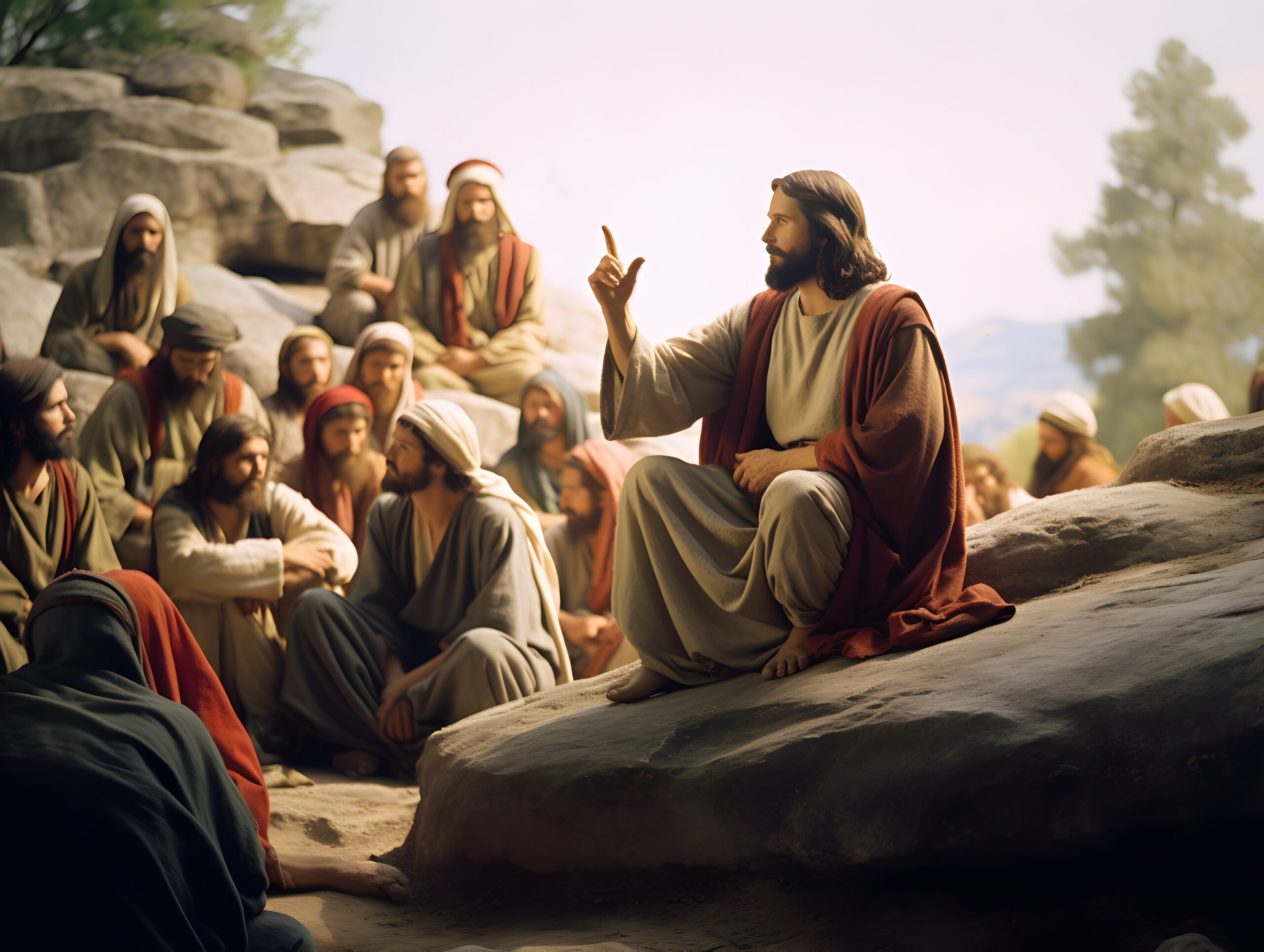
To best envision that Galilean morning two thousand years ago, please understand that Jesus with His disciples had likely just been walking for days. This was what Jesus very often did, as a charismatic itinerant Teacher. He would walk for days sometimes, stopping often along the way to eat, sleep, teach, and heal people. He could see now that He had gathered a tremendous crowd of listeners along the way:  think of ten thousand people, or even more, who were following him just  to hear a lot more from Him! He noticed a likely hill that He could teach them from, so he went up the hill maybe thirty or forty feet and sat down, and He called his disciples to come and sit around Him, which was a signal for that gigantic crowd to stop walking and back up and settle down in groups onto the ground all around them and back down that long valley. It is thought that while the crowd was in the process of settling, Jesus gave to mainly his own disciples the more sophisticated teaching that is the Beatitudes, which was what we studied last week. But then, once the crowd had mostly settled, came the literal fire and brimstone that we are about to receive this week!

(What is most surprising about this week’s teaching is that in it, Jesus uses such a thoroughly modern technique. He uses the technique of argument from extremes to altogether reset His listeners’ attitudes toward our relationships with others AWAY from just the minimal standards that the old Judaic Law that they had known for their whole lives required, and TOWARD the utmost perfection that is demanded by God’s new internal Law of Love. There is nothing subtle or even literal about His words here at all, and it would probably be another fifteen hundred years, and well into what we would  much later refer to as the Middle Ages, before very much more educated people could be trusted actually to hear some of what Jesus is saying to us today with the same level of sophistication with which Jesus is saying and meaning it!  I mean, good grief, did they think he was telling them to cut off hands and pluck out eyes LITERALLY? We can have no way to know how Jesus’s very first listeners heard some of this, but to be frank, until I was maybe fifty years old and I had absolutely convinced myself with a lifetime of afterlife research that there really is no fiery hell, I was pretty alarmed by some of this!)

Personal Relationships (Again, these headings are just in the Bible, and they were of course not spoken by Jesus.)

21 “You have heard that the ancients were told, ‘You shall not commit murder’ and ‘Whoever commits murder shall be liable to the court.’ 22 But I say to you that everyone who is angry with his brother shall be guilty before the court; and whoever says to his brother, ‘You good-for-nothing,’ shall be guilty before the supreme court; and whoever says, ‘You fool,’ shall be guilty enough to go into the hell of fire. 23 Therefore if you are presenting your offering at the altar, and there remember that your brother has something against you, 24 leave your offering there before the altar and go; first be reconciled to your brother, and then come and present your offering. 25 Make friends quickly with your opponent at law while you are with him on the way, so that your opponent may not hand you over to the judge, and the judge to the officer, and you be thrown into prison. 26 Truly I say to you, you will not come out of there until you have paid up the last cent.

(Gehenna was a valley just outside Jerusalem where they burned trash, so fires were always burning there. Depending upon which Biblical translation you read, that word might be translated throughout the Sermon on the mount as “hell of fire”, but I have been kind and done that only the first time it appears here! Just think “hell” each time you see “Gehenna” hereafter. You can imagine how, as a teenager who had not yet begun to do afterlife research and eventually discovered that no hell exists, I had found reading this part of The Sermon on the Mount and found Jesus here repeatedly referencing “hell” to be terrifying!)

27 “You have heard that it was said, ‘You shall not commit adultery’; 28 but I say to you that everyone who looks at a woman with lust for her has already committed adultery with her in his heart. 29 If your right eye makes you sin, tear it out and throw it from you; for it is better for you to lose one of the parts of your body, than for your whole body to be thrown into Gehenna. 30 If your right hand makes you sin, cut it off and throw it from you; for it is better for you to lose one of the parts of your body, than for your whole body to go into Gehenna.

(President Jimmy Carter is remembered for having told us that he was troubled by this passage, because he had, he very sadly said, often looked at women other than his wife with a bit of lust!)

31 “It was said, ‘Whoever sends his wife away, let him give her a certificate of divorce’; 32 but I say to you that everyone who divorces his wife, except for the reason of unchastity, makes her commit adultery; and whoever marries a divorced woman commits adultery.

“Again, you have heard that the ancients were told, ‘You shall not make false vows, but shall fulfill your vows to the Lord.’ 34 But I say to you, make no oath at all, either by heaven, for it is the throne of God, 35 or by the earth, for it is the footstool of His feet, or by Jerusalem, for it is the city of the great King. 36 Nor shall you make an oath by your head, for you cannot make one hair white or black. 37 But let your statement be, ‘Yes, yes’ or ‘No, no’; anything beyond these is of evil.

(Some translations say here, “anything beyond these is from the evil one”, and thereby they imply the existence of an incarnate Devil. My afterlife research has never found any evidence for an incarnate Devil as such, so this is another thing that once bothered me about The Sermon on the Mount, but this more accurate translation feels more comfortable.).   

38 “You have heard that it was said, ‘An eye for an eye, and a tooth for a tooth.’ 39 But I say to you, do not resist an evil person; but whoever slaps you on your right cheek, turn the other to him also. 40 If anyone wants to sue you and take your shirt, let him have your coat also. 41 Whoever forces you to go one mile, go with him two. 42 Give to him who asks of you, and do not turn away from him who wants to borrow from you.

(I love this! The Code of Hammurabi, or as it is sometimes called, “The Law of Retaliation” dates to about 1790 BCE, and it is said to be the base of the Torah, and therefore of both Jewish and Christian law. Jesus here replaces it with a kind of opposite law of radical peace and perfect love.)

43 “You have heard that it was said, ‘You shall love your neighbor and hate your enemy.’ 44 But I say to you, love your enemies and pray for those who persecute you, 45 so that you may ]be sons of your Father who is in heaven; for He causes His sun to rise on the evil and the good, and sends rain on the righteous and the unrighteous. 46 For if you love those who love you, what reward do you have? Do not even the tax collectors do the same? 47 If you greet only your brothers, what more are you doing than others? Do not even the Gentiles do the same? 48 Therefore you are to be perfect, as your heavenly Father is perfect” (MT 5:21-48).

 (Here we learn directly from Jesus that our goal is no longer to keep just the minimal standard of righteously obeying the ancient laws handed down from God thousands of years ago. Oh, no!  Now, my dear ones, our goal must be, and it can only be nothing less than to achieve God’s Own level of pure and perfect love!)

In Chapter Five of the Gospel book of Matthew, Jesus powerfully teaches you and me a full master-class in spiritual growth toward our own personal spiritual perfection. As we go back over last week’s black letters, and then add to them this week’s powerful black letters, we are so grateful to our cherished  Elder Brother and Best Friend for the fact that He never talks down to us. No, even though we are still spiritual children, so He is speaking to us in straightforward terms, He does not hold back. He really does tell it to us precisely the way that it is! He knows that when we very soon go home, we are not going to be able to fudge things at all, but we will be able to achieve only the level of the glorious astral plane which is our true home that we have achieved in terms of our growth in love while we were here on earth. We will achieve that, but no higher. So, hold tight now. They are passing the bread and the water-jugs below us in the valley. It is barely noon on this Galilean hill, and we have two more wonderful chapters of the Gospel of Matthew still to go….

For the church, that evermore
Lifteth holy hands above,
Offering up on every shore
Her pure sacrifice of love.
Lord of all, to Thee we raise
This our hymn of grateful praise.

For Thyself, best Gift Divine.
To us all so freely given,
For that great, great love of Thine,
Peace on earth and joy in Heaven.
Lord of all, to Thee we raise
This our hymn of grateful praise.
– Folliot Sandford Pierpoint (1835-1917), from “For the Beauty of the Earth” (1864)


(Many photos are from Vecteezy.com)


Hearing Jesus #1

Morning has broken like the first morning.
Blackbird has spoken like the first bird.
Praise for the singing, praise for the morning,
Praise for them springing fresh from the world.

Sweet the rains new fall, sunlit from Heaven,
Like the first dewfall on the first grass.
Praise for the sweetness of the wet garden,
Sprung in completeness where His feet pass.

Mine is the sunlight, mine is the morning,
Born of the one light, Eden saw play.
Praise with elation, praise every morning,
God’s recreation of the new day.
– Yusuf/Cat Stevens, from “Morning Has Broken” (1971)

The thing that vexes and confounds my beloved Thomas and me most of all about modern Christianity is the fact that, while it loudly and everywhere proclaims the name of Jesus, the religion does so very little to share any of the teachings of Jesus. And this is true, even when Jesus Himself tells us that sharing God’s Word is the reason why He returned to earth from the Godhead as Jesus two thousand years ago! He was then a perfected Being, and troubled very much by the fact that so few people on earth understood why they were living on earth at all, so they learned very little in each earth-lifetime. As a result, so many of them were spending so many additional and unnecessary lifetimes, as the Buddha had said that so many people then were doing, just “turning on the wheel” unproductively. Jesus tells us that it was His purpose in being born on earth with the name of Jesus, which was then a common name, and as a simple Jewish preacher, well-educated but poor and living here dependent on the kindness of others. Jesus came as God’s messenger to the Jews, who were God’s chosen people and the world’s first true monotheists, to teach them how they could spiritually achieve the kingdom of God in this earth-lifetime.

As Jesus still insists to you and me, “If you hold to my teaching, you are really my disciples. Then you will know the truth, and the truth will set you free” (JN 8:31-32). He tells us that if we only will listen to His teachings, and if we then will follow His teachings, we can make this our last necessary earth-lifetime! But, what? You aren’t finding what you need to make rapid spiritual progress in your own open Bible? Jesus says that all you need to do then is to, “Ask, and it will be given to you; seek, and you will find; knock, and it will be opened to you. For everyone who asks receives, and he who seeks finds, and to him who knocks it will be opened” (MT 7:7-8). My darling friends, our beloved Lord, the risen Jesus Christ could not possibly make this process any simpler for us! But the problem is that none of the more than forty thousand different versions of Christianity actually makes a priority of the sharing of all of Jesus’s teachings in a way that makes them useful to us. Catholicism certainly doesn’t do it! I was a Catholic for twenty-five years, and I even was a Lector, doing formal readings as part of each week’s Mass, so I can tell you that what teaching ever was done in those Catholic churches was primarily sin- and retribution-related. Even Protestants will read brief sample passages from the whole Bible during their church services, rather than treating the important long passages of the Gospel teachings of Jesus as the pearls of great value that they are.  

Jesus said, “The kingdom of heaven is like a treasure hidden in the field, which a man found and hid again; and from joy over it he goes and sells all that he has and buys that field” (MT 13:44). But he bought the whole field, for heaven’s sake! Dribbling to people these few words from Jesus that we get in our churches each week is like tossing crumbs to people who are starving. Yes, we each desperately seek for ourselves that spiritual pearl of great value. But to get it, we need to buy the whole precious field. It is just not up to some church or other to decide that these few words, or those other few words from Jesus’s more than three years of teaching, are all that you or I in particular might need to read this week of Jesus’s teachings.  So, Thomas and I have thought about how we might best help you to find a sufficient way to feast on the Lord’s whole banquet of teachings, and without any more delay. As we look now toward the time of year when we will celebrate the great gift of Jesus’s birth to us, let’s pause and consider what an amazing gift all those teachings of our greatest Teacher ever born truly are!  

While Jesus’s teachings come to us throughout all four Gospels, the gift appears in its most concentrated form in what is called “The Sermon on the Mount”, in the Book of Matthew, Chapters 5-7. So it now occurs to us that what we might do is to give you The Sermon on the Mount in comfortable, sermon-length sections over the six weeks of late November and early December that remain between now and when we will celebrate the birth of Jesus, our beloved Teacher. Some of you have told us that you use our weekly blog posts as your alternative to a Sunday sermon; so for the next six weeks, we will try more seriously to live up to that responsibility for you. (Thomas has just remarked as we are writing this that we will need to add an organ processional for you, too, then. I giggled.)

When Jesus was here on earth, He was the most charismatic speaker you can imagine. He had His twelve official male Disciples, of course; but once He began His public ministry, He soon was followed by a crowd that very soon grew to thousands of people, mostly men but also women and children, too, who were mesmerized by the things that he was saying, and by the brilliant and profoundly authoritative way that He said those things! They followed him for days, more and more of them, trailing along the hillsides, stopping sometimes in little villages to eat, but mainly just following Him, until their groups amounted to crowds of followers numbering in the tens of thousands. They won’t even notice when a few thousand more of us join them now. And so, with this little prelude, let’s begin this week to read together Chapters Five through Seven of the Gospel Book of Matthew. 

(Our suggestion is that in reading these Gospel words below the first time through, you might include our parenthetical explanatory notes. But then, go back and read just Jesus’s precious words, in dark print. Literally, sit on that hillside and hear Jesus speak!)

When Jesus saw the crowds, He went up on the mountain (it was the side of a hill); and after He sat down, His Disciples came to Him. He opened His mouth and began to teach them, saying, (Envision His Disciples close around Him, and a hillside and valley full of many thousands of others, milling and then sitting down in groups around us, all listening….)

The Beatitudes (This term roughly means “blessed attitudes” in Latin. Here Jesus powerfully begins by listing nine perhaps sometimes unpleasant-seeming situations in which His listeners might find themselves, as His followers. And yet, He is telling them, and us, that in these situations we are in fact uniquely blessed, and uniquely able to find an even deeper and more joyous relationship with God. And all these organizing titles are not spoken by Jesus, but rather they are in the Bible.)

“Blessed are the poor in spirit, for theirs is the kingdom of heaven. (“Blessed” in these nine Beatitudes means “fortunate” or “favored”. And “Poor in spirit” means something like “meek” or “humble”.)

“Blessed are those who mourn, for they shall be comforted.

“Blessed are the gentle, for they shall inherit the earth. (Here again, He tells us that the meek, and not the strong and powerful, will prevail.)

“Blessed are those who hunger and thirst for righteousness, for they shall be satisfied.

“Blessed are the merciful, for they shall receive mercy.

“Blessed are the pure in heart, for they shall see God.

“Blessed are the peacemakers, for they shall be called sons of God.

10 “Blessed are those who have been persecuted for the sake of righteousness, for theirs is the kingdom of heaven. (We might think of our achieving “the kingdom of heaven” as our achieving so much personal spiritual growth away from negativity and toward love in this lifetime that we never will need to incarnate on earth again.)

11 “Blessed are you when people insult you and persecute you, and falsely say all kinds of evil against you because of Me. 12 Rejoice and be glad, for your reward in heaven is great; for in the same way they persecuted the prophets who were before you.

Disciples and the World. (Jesus is speaking to the whole crowd, whoever will listen, and also to us and to the World. He is not speaking just to His Twelve Disciples.)

13 “You are the salt of the earth; but if the salt has become tasteless, how can it be made salty again? It is no longer good for anything, except to be thrown out and trampled under foot by men. (Salt was very important and valuable in that time and place, not just to enhance flavors but also to preserve food. So in calling us “the salt of the earth”, Jesus is saying something both complex and empowering.)

14 “You are the light of the world. A city set on a hill cannot be hidden; 15 nor does anyone light a lamp and put it under a basket, but on the lampstand, and it gives light to all who are in the house. 16 Let your light shine before men in such a way that they may see your good works, and glorify your Father who is in heaven. (This is such an immensely powerful statement! Jesus is saying here that YOU, my very dear one, are a literal light unto all mankind! Here you and I are, thinking that Jesus came into this world to be that light unto the world. But now He is telling us that, no, it is the people that He is speaking to now, the ones sitting on that hillside, and YOU AND I as well, my beloveds in this twenty-first century, who have come into this world to be the light of the world! And Jesus tells us that it is our task now to further glorify our Father, who is in heaven.)

17 “Do not think that I came to abolish the Law or the Prophets; I did not come to abolish but to fulfill. 18 For truly I say to you, until heaven and earth pass away, not the smallest letter or stroke shall pass from the Law until all is accomplished. 19 Whoever then annuls one of the least of these commandments, and teaches others to do the same, shall be called least in the kingdom of heaven; but whoever keeps and teaches them, he shall be called great in the kingdom of heaven. (We will have more to say about this below….)

20 “For I say to you that unless your righteousness surpasses that of the scribes and Pharisees, you will not enter the kingdom of heaven. (Not surprising to hear. We know how low is Jesus’s opinion of the scribes and Pharisees, the clergymen of His day!) (MT 5:1-20)

…Wow! And so ends the first part of the Sermon on the Mount. Now let’s pause here for a week, still holding our place on that hill, perhaps passing around a basket of bread and a jug of water or wine as we ponder what we have heard of Jesus’s teachings today. But our best-beloved Teacher has only begun what will be a long day of sitting on that hillside and speaking, while the crowd of thousands of us listens to Him, sitting ranged along the hillside and below us in the valley, and that crowd will gradually grow ever larger as word spreads that the Teacher is teaching nearby. A few of you are looking over at Thomas and me, though, and are wondering about something. “What?” Someone now whispers to Thomas. “What was that He said about ‘The Law and The Prophets’? I thought we were going to be past those old laws?”

Thomas smiles at his questioner. He says, “Ah, but remember that the Pharisees are always listening to Him.” And Thomas points out a few of those feared clergy, close by Jesus even now, farther up on the hill from us and doing their spying. Remember what the Master has told us privately of the Law and the Prophets, which is the whole of what Christianity will one day in the far future call the entire Old Testament. Jesus has told us that there are really only two commandments, in the end. Remember that? He said, “‘You shall love the Lord your God with all your heart, and with all your soul, and with all your mind.’ This is the great and foremost commandment.  The second is like it, ‘You shall love your neighbor as yourself.’ On these two commandments depend the whole Law and the Prophets” (MT 22:37-40). And so, our very dear ones, simply love and trust God with your whole heart, and allow Jesus now to be your wise Elder Brother and Teacher, which is what He returned to earth two thousand years ago to very gently be for us all. We’ll return together to hear Him on His hillside next week, since He has barely begun!

Morning has broken like the first morning.
Blackbird has spoken like the first bird.
Praise for the singing, praise for the morning,
Praise for them springing fresh from the world.
– Yusuf/Cat Stevens, from “Morning Has Broken” (1971)


(Many photos are from Vecteezy.com)

 

Our Declaration

… O beautiful for spacious skies,For amber waves of grain,For purple mountain majestiesAbove the fruited plain!

… America! America!
God shed His grace on thee,And crown thy good with brotherhoodFrom sea to shining sea!

O beautiful for pilgrim feet,
Whose stern, impassioned stress
A thoroughfare for freedom beat
Across the wilderness!

America! America!
God mend thine every flaw,
Confirm thy soul in self-control,
Thy liberty in law!
– Katharine Lee Bates (1859-1929), from “America the Beautiful” (1893)

Ours is a spiritual, and never a political blog. But Thomas and I hope you will indulge our wish to talk this week about something that matters to us very much indeed, because unless Americans can remain free to think for ourselves, then a healthy spiritual life will not remain possible for any of us. And, my dear ones, next Fourth of July in the United States we will celebrate the two hundred and fiftieth anniversary of this nation’s very fortunate birth. For two and a half centuries, through great and also through some pretty awful presidents; through the kind of strife that we are witnessing yet again; and through even a bloody nationwide civil war: the United States of America has seen the steady, ongoing election of presidents every four years, and the ongoing protection of each precious citizen’s sacred personal rights and freedoms by a strong Constitution administered by a Congress of the people, and by a highly respected Supreme Court. And by now, all of our sacred institutions have been battered enough to have been proven to be soundly able to withstand whatever we can throw at them. There is no other nation on the face of this earth that has had such an amazingly long, unbroken stretch of one continuous government. And our winning that longevity contest is not even close!  

It is time for those of us who are privileged to be Americans to marvel together at what we possess, and to stop just taking it all for granted. Because it did not have to turn out this way. In every other country, even now, if you slip and say the wrong thing in public, you risk jail time. But not in the United States, where we know that our First Amendment will protect us. Some people tease that Donald Trump might get a third term as president, if maybe JD Vance is elected president with Trump as his vice president, and then Vance resigns. But, nope! We know we’ve got our Twenty-Second Amendment safely in their way. And we know by now that no foreign country is going to attempt to conquer this nation, since our Second Amendment right to individually bear arms means that Americans own tons of guns and bullets, so any foreign army would have to conquer us house by house and street by street. It’s wonderful, the way so many Americans can rattle off even the numbers of these Constitutional amendments that protect each of our sacred rights.

 But the key founding document of the United States is not its Constitution. Instead, it is the faded sheet that was signed on the Fourth of July in 1776. Our Declaration of Independence from Great Britain’s monarch, who before that day could claim to own the thirteen north American colonies, is this nation’s true founding document. And it has set our country’s flavor and tenor ever since. Only marvel at the way it begins, with two paragraphs that bring a new and better dawn for all of humankind!

In Congress, July 4, 1776. The unanimous Declaration of the thirteen united States of America. When in the Course of human events, it becomes necessary for one people to dissolve the political bands which have connected them with another, and to assume among the powers of the earth, the separate and equal station to which the Laws of Nature and of Nature’s God entitle them, a decent respect to the opinions of mankind requires that they should declare the causes which impel them to the separation.

We hold these truths to be self-evident, that all men are created equal, that they are endowed by their Creator with certain unalienable Rights, that among these are Life, Liberty and the pursuit of Happiness.–That to secure these rights, Governments are instituted among Men, deriving their just powers from the consent of the governed, –That whenever any Form of Government becomes destructive of these ends, it is the Right of the People to alter or to abolish it, and to institute new Government, laying its foundation on such principles and organizing its powers in such form, as to them shall seem most likely to effect their Safety and Happiness….

This document is literally over-the-top amazing! In that much younger world, in which no united people anywhere on the face of this earth had ever before that sacred date been free from a strong, overbearing, often brutal, and always highly fallible government of and by the very few, our Declaration of Independence does not only declare our colonies’ separation from Great Britain. Also, and very far more importantly, for the first time in history, our Declaration of Independence claims FOR EACH OF THE PEOPLE INDIVIDUALLY who were living in these colonies a whole new human reality! It sets forth the overriding principle that ONLY THE PEOPLE have the power and the right to rule themselves, individually! And furthermore, if the people as individuals are ever not happy with their government, then it is their absolute and unfettered right as individuals to peacefully change their government, whenever and however they like. In colonies in which some people were still being held as slaves by other people, it also sets forth the overriding principle that all men are created equal! And to deny slaveholders the right to declare other human beings to be their property, this document revises what had always until then been the standard mantra of rights from “life, liberty, and property”, and instead it proclaims our universal rights now to be “Life, Liberty, and the pursuit of Happiness”. This seems actually to invite those still being held as slaves in the American colonies to claim the great happiness of their own freedom, and it urges them to make that claim just as soon as they can manage it.

This extraordinary preamble to the Declaration of Independence is followed by a long list of the colonists’ grievances against the British king, the most prominent of which in the first draft of the Declaration of Independence is this:

He (the British King) has waged cruel war against human nature itself, violating it’s most sacred rights of life & liberty in the persons of a distant people who never offended him, captivating & carrying them into slavery in another hemisphere, or to incur miserable death in their transportation thither. this piratical warfare, the opprobrium of infidel powers, is the warfare of the CHRISTIAN king of Great Britain. determined to keep open a market where MEN should be bought & sold, he has prostituted his negative for suppressing every legislative attempt to prohibit or to restrain this execrable commerce: and that this assemblage of horrors might want no fact of distinguished die, he is now exciting those very people to rise in arms among us, and to purchase that liberty of which he has deprived them, & murdering the people upon whom he also obtruded them; thus paying off former crimes committed against the liberties of one people, with crimes which he urges them to commit against the lives of another.

Of course, this tirade against slavery was not allowed to remain in the Declaration of Independence. Indignant representatives of the Southern slave-holding states removed it right away. But those same Southerners missed the anti-slavery nuances that the Declaration’s clever principal author had hidden in the Declaration’s preamble, so there those words remained. And that principal author of the Declaration of Independence was a Southerner himself, and someone who had inherited hundreds of slaves. He was thirty-three-year-old Thomas Jefferson. The same Thomas who, soon after he later finished one final earth-incarnation as a Welsh farmer, which he tells me that he took in order to “get back into balance” after his extraordinary Thomas Jefferson lifetime, he then became my spirit guide. My Thomas now co-authors these weekly blog posts, and while he is not any longer Thomas Jefferson – more on that later – the way Jefferson got so much anti-slavery language into the Declaration of Independence right under the Southern slaveholders’ noses still to this day makes my Thomas smile.   

Long before I knew that Thomas was my spirit guide, he guided me in researching and writing an accurate account of Thomas Jefferson’s ten-year marriage to Martha Wayles Skelton, which marriage neatly spanned the Revolutionary War. Thomas and Martha were married on January 1, 1772, and it truly was a love-match. But Patty – her nickname – was repeatedly pregnant, and she became ever more sickly with each child she bore. Her father was an importer of slaves, and her mother had died young, so Betty Hemings, her father’s half-white slave mistress, and the woman who had raised Patty, had made of Jefferson’s future wife into an adamant abolitionist. And so, apparently, was Thomas Jefferson a pretty ardent abolitionist as well, at least while his adored wife was alive. Thanks to Jefferson, the colony of Virginia became the first place on earth to ban the importation of slaves, even before Great Britain did it. And we have seen above what Jefferson did with the first draft of the Declaration of Independence! In fact, my research at Monticello suggests that he was starting to plan to make abolition the great cause of the rest of his life. Jefferson made it clear in his contemporary writings that as soon as the Revolutionary War ended, he meant to retire “to my family, my farm, and my books.”

 But all of that was not to be. Patty’s illness was diabetes, and in September of 1782, just as the Revolutionary War was winding down, she delivered her last child, Lucy, and four months later Patty died with her husband at her side, at the age of just 34. Jefferson never really was the same man again. And he burned all their letters to one another, and all her personal papers, no doubt to protect her from the judgment of those who might not share her fiercely abolitionist views.

 Martha Jefferson’s death may have had major historical ramifications. Before her death, it was her husband’s clear intention to devote the rest of his life to the abolition of slavery in the nation that he had helped to found. The primary problem was that racism was rampant, so whenever slaves were freed, they were horribly treated. Jefferson’s first sympathetic thought, to offer to send the slaves back to their native countries, would never have worked because they had been here for generations. So, by the time of Patty’s death, Jefferson was looking at experimenting with how we might do a proper emancipation by giving the newly freed slaves their own state initially, where they could live on farms checker-boarded with farms owned by sympathetic white farmers in the still-wild interior perhaps, and people could get to know one another and come together gradually, peacefully, and with appropriate Christian customs and supports in place. Personally, I have no doubt that if fixing this racial problem had become his and a healthy Patty’s whole life’s goal, they could have fixed it all by, perhaps, 1820 or so. Then there would have been no American Civil War. And no ongoing Jim Crow racial strife for most of the whole century thereafter. Then Thomas Jefferson would be known only for his Declaration of Independence, and for his brilliance in having so well and properly freed the slaves and created the healthily race-blind United Stated that we are blessed with only now, 250 years later. But instead, that poor man fled Monticello for decades after his wife’s death. He helped to negotiate the peace in France. He then became the first Secretary of State, the second Vice President, and the third President of the United States. Thomas Jefferson was a great American Founding Father, but it was a consolation life, and not the life he had wanted.

When I researched My Thomas at Monticello, I discovered that Jefferson had been a rather surprising slaveholder. He had inherited this institution that he deeply hated, and for much of his life, emancipation was not even legal in Virginia. So his hundreds of inherited people lived communally with him at Monticello on family plots where they grew vegetables that they then sold to their master’s kitchen. Yes, really! And since Jefferson often didn’t have the cash to pay them right away, he would keep account books, which I saw, listing what he owed to his slaves for their vegetables. They had Sundays off, and often Saturdays too, except in harvest season, when everyone had to work all seven days. Their overseer was himself a slave, since white overseers would treat slaves like, you know, actual slaves. There is no record of Jefferson’s ever allowing a slave to be beaten or mistreated, except for once, in his old age, when he allowed it for an insufferable young man. But just that once upset him so much that he never allowed it again.

When, in 2015, my spirit guide came out to me as having been Thomas Jefferson in an earlier lifetime, I had just one question for him. You may well know what it was. I had done enough research to be confident that the Sally Hemings children who had Jefferson DNA had been fathered by Thomas’s younger brother, Randolph, and not by Thomas himself; but I wanted to know that from him directly. My Thomas insisted that I must ask Thomas Jefferson himself that question. So that next night, while my body slept, Thomas whisked me to the astral plane, and to a small eighteenth-century-style reception room, where stood Thomas Jefferson himself. Wow! Picture this! Two tall men, Jefferson wearing his eighteenth-century garb for me, and my Thomas, even taller and in his long blue sixth-level robe and his Fu Manchu mustache. We recognize people in the astral plane by their spiritual vibrations, and these two vibrated almost identically, although Thomas did vibrate a bit higher and more rapidly than did Jefferson. But, notice that they are two different beings now! I find that fascinating! When I am in my astral body, I think I look as I did when I was about thirty years old, with long hair. Thomas nudged me to ask my question, so I did that, shyly.

Thomas Jefferson smiled gently at me. He could see that I was embarrassed to be asking him such a personal question. Then he said in his beautiful soft, southern voice, “I could not have been intimate with Sally Hemings because she was my property so she could not have consented.” And I thanked him. What could I say? Above all, the man was a gentleman.

My dear ones, what Thomas Jefferson and his American generation of giants did most of all was to present to humankind for the first time in human history the notion that each man has the precious right to govern himself. That is why our Declaration of Independence and its upcoming 250th anniversary are so important, and not just to Americans, but really to all the world. Government must not be from the top, working too often for just a greedy few; but really, it can only be by each of us, working together, for the good of us all.


O beautiful for patriot dream
That sees beyond the years
Thine alabaster cities gleam,
Undimmed by human tears!

America! America!
God shed His grace on thee,
And crown thy good with brotherhood
From sea to shining sea!
– Katharine Lee Bates (1859-1929), from “America the Beautiful” (1893)


(Many photos are from Vecteezy.com)



Proving God?

My sweet Lord, Mmm,
My Lord, Mmm, my Lord,
I really wanna see you,
Really wanna be with you
Really wanna see you, Lord
But it takes so long, my Lord

My sweet Lord, Mmm,
My Lord, Mmm, my Lord,
I really wanna know you
I’d really wanna go with you

I really wanna show you, Lord
That it won’t take long, my Lord
(Hallelujah)
My sweet Lord (Hallelujah)
Mmm, my Lord (Hallelujah)
My sweet Lord (Hallelujah)
– George Harrison (1943-2001) & Billy Preston (1946-2006), from “My Sweet Lord” (1970)

What my Thomas and I have been talking about in this space for the past few weeks has prompted a few of you, my dear friends, to ask us whether in fact we can prove that there is a God. I think we can prove that God is real, although you should not be reduced to having to ask lowly us such a very important question! Oh, my dearly beloved Father, our Father not in heaven but within us, all around us and all through us! How You must be laughing at the absurdity of all your precious children, that we are reduced to such confusion, even now, in the twenty-first century! We could have proven Your existence a hundred thousand times over by now, and in at least as many ways, and it would not even have been hard. But those patently ridiculous scientific gatekeepers, the heads of the university scientific departments and the peer-reviewed scientific journals, they quite literally destroyed their own discipline in their foolish panic over the advent of quantum mechanics at the start of the twentieth century. Their minds were boggled, because they thought that a very ancient arbitrary line between science and religion had back then been crossed.

Well, yes, true enough, that arbitrary line had indeed been crossed. But it was a stupid line in the first place. The line that the first quantum physicists had crossed was a kind of gentleman’s understanding that goes back some twenty-five hundred years, all the way back to those great Greek philosophers, Plato and Aristotle. When I asked AI, our handy new expert on all things, to summarize Plato’s and Aristotle’s gentleman’s understanding for us so I could better explain it to you, here is what it said: “Plato was an idealist who believed truth and reality exist in a perfect, non-physical realm of “Forms,” accessible through reason and intellectual insight. In contrast, Aristotle was a realist who argued that reality is found in the physical world and is best understood through observation, experience, and logic. Key differences include Plato’s focus on abstract ideals versus Aristotle’s emphasis on the concrete and empirical, as well as their differing views on the ideal state and the nature of the soul.” So, Plato was sort-of the father of religion, while Aristotle was more or less the father of science. It made some kind of sense to the ancient Greeks to follow their two great, heroic thinkers, and to split all human inquiry into the fields of religious inquiry and scientific inquiry. So western thought has followed that  artificial pattern forever after. And never the twain shall meet!

Therefore, when more than a century ago it appeared to the mainstream scientific gatekeepers that quantum physicists might be close to becoming too spiritual, they panicked and imposed their “scientific dogma of materialism” on all scientific disciplines, as a stark prohibition on any scientist’s ever discovering God. Nope! Can’t do that, even if the genuine Creator behind it all is staring right at you from one of your test tubes, and winking at you, and even waving to boot. Since in fact, of course, a Creator and Designer, a vastly clever Great Engineer does exist, and by now that Creator’s efforts are bountifully evident everywhere, watching scientists go about their work while they are still hobbled by that ridiculous old dogma, and therefore not allowed to notice that Creator’s work on pain of destroying their own careers is, quite literally, laugh-your-head-off funny, even despite the fact that it is also so tragic. Let’s look at just two current articles describing ways in which working scientists are still dealing with their by-now badly creaking materialist handicap:

Consciousness

OMG, talk about imposing a handicap! Here is a very convenient article from our personal favorite popular science magazine that catalogues more than three hundred and fifty different theories about the origin and persistence of consciousness, both materialist and non-materialist, which, taken together, detail what the current guesses are, since of course they still must ignore the fact that consciousness is primary. Consciousness is God. But their guesses here are boggling. They make your head hurt. Trust me on this: to attempt to read this article, and to follow out its charts, does indeed give you such a headache! Look, most of these hundreds of theories can be proven to be dead-ends simply by testing them against some of the ways in which we know that consciousness actually works. For example, life after death is a proven fact, based on so much overwhelming evidence that is now more than a century old. None of the materialist guesses at the sources of consciousness which have it originating in the human brain will allow for consciousness to survive the death of the brain, so all of those theories can now be safely ruled out. Phenomena like terminal lucidity, remote viewing, and near-death experiences are all frequently reported, too, so they also demonstrate that consciousness does not originate inside the human brain. If your theory of consciousness won’t allow for all of these commonly-occurring, consciousness-related phenomena, then it is a frank non-starter.  

 Advanced Physics Research

Some modern physicists have been reinventing their field, including attempting to put information at its center.  I am not sure why this is true, but I imagine it is because, to date, neither physics nor any other core scientific discipline has solved some of the most important remaining scientific questions, which seem to amount to these: What first prompted cells to begin to assemble themselves into organisms? And how did life begin? I would propose one more scientific question, which to me overrides them all: how is it possible that the human body is so exquisitely and complexly designed, with all its systems working so well together, if there is no Designer, and if our existence has no apparent purpose at all?  The team in the video linked at the top of this paragraph cannot answer any of these questions, of course, not with that atheist materialist dogma still in place; but you will enjoy the fresh zest with which the two in this video are at least trying to answer them! And my goodness, we can see how deeply they are struggling with that useless dogmatic limitation on their work, and how brilliantly they are trying to find ways to get around it. They cannot find a source for life, and you get the sense that they realize they probably never will find a source for life while their artificial professional restraint remains in place. These dear physicists are smart enough to be realistic about their sad professional handicap, above all.  

Yes, Dr. Max Planck, who was the father of quantum physics, did in fact find God more than a century ago. And he was so joyous about it! Even the death of his son Erwin at Hitler’s hands in 1944 after a failed assassination plot could not, in the end, stem his delight in his discovery. Dr. Planck, who won the 1918 Nobel Prize in Physics as the father of quantum mechanics, insisted that it was impossible for us to “get behind” consciousness. He told us, in other words, that consciousness is the base, the grounding, the Source of all reality. In 1944, the same year that he lost his son, he said, “As a man who has devoted his whole life to the most clear-headed science, to the study of matter, I can tell you as a result of my research about atoms this much: There is no matter as such. All matter originates and exists only by virtue of a force which brings the particle of an atom to vibration and holds this most minute solar system of the atom together. We must assume behind this force the existence of a conscious and intelligent mind. This mind is the matrix of all matter.” Bingo! That stupid artificial line separating science and religion that Plato and Aristotle had set up twenty-five hundred years ago was arbitrary and foolish to begin with, when reality is all of a single piece! It is past time for us to give Max Planck full credit for ending that old artificial split, since that he certainly did, a full century ago.

Max Planck discovered, too, that God is Consciousness. And a significant number of the more than 350 theories about consciousness that were cited in the New Scientist article linked earlier in this post also suggest something like that. Even my beloved spirit guide, Thomas, when I was four years old and he was teaching me to memorize my address, told me that we live within the Mind of God. And, so we do! This whole universe, and the entire gigantic astral plane which is our genuine eternal home, and much more besides: all of it is a thought in the Mind of God. And so when, early last century, those in the afterlife told us that dying and going to the afterlife was a lot like just changing to a different radio station, of course that idea made perfect sense!

The real problem with the materialist dogma that those scientific gatekeepers more than a hundred years ago imposed on some of the greatest scientific minds that ever have lived was that it largely halted the advance of open-minded scientific investigation altogether. For the past hundred and twenty-five years, no scientific query ever has been answered by positing a Creator behind what is clearly a deeply results-driven and highly purposeful creation, which therefore leaves all deep thinkers enmired in confusion. Only stop and think about this for a moment! We speak glibly about evolution, as if of course evolution happens. But why would life ever bother to evolve at all, if it never had a more complex creature in mind, toward which it was inspired to spur its own evolutionary changes? Why did all the aspects of our mouths, throats, and lungs evolve together toward human speech? Why bother? What was the point? Why did our bodies evolve toward bipedalism? For that matter, why did ancient sea creatures not simply continue to evolve, entirely randomly, in just the seas? Or, why did they bother  even to evolve at all? Why did any two or more unicellular creatures ever take the extreme trouble, at any point in all those billions of years, of ever bothering to combine into anything more complex?

By far the greatest proof that a Creator must exist is that YOU exist. And the odds against your existing at all are something like one in four hundred quadrillion, according to our AI friend, although given the extreme likelihood that this universe will either blow apart or collapse in upon itself in any given micro-instant if all those “cosmological constants” that keep this universe stable should ever stop micro-adjusting for even one tiniest speck of a second, even those odds seem to be underestimating the extreme precariousness of our shared situation. (And yes, they were called “cosmological constants” before scientists realized that they are continuously being micro-adjusted by… Guess-Who. Now scientists try to ignore them.) The Creator that our scientific gatekeepers are so terrified of inadvertently finding is also an infinitely loving paterfamilias to all eight billion of us, and to all of  created reality. Max Planck happily understood that. And so, by now and very long since, should we also understand and accept it, too. As we all learned back in high school, matter can neither be created nor destroyed, but it merely changes in form.

Indeed, our bodies are marvels of intelligent design! Here is the first in a series of videos that will show you just how unbelievably complex and efficient your own body’s divine engineering actually is (we begin with talking about our bodies’ use of oxygen). Again, my very dear ones, such incredibly complex engineering strongly implies that, without a God, of course a whole tribe of brilliant post-doc-trained engineers must surely have been transported from now to very far back in time! Or else, you know, one very brilliant Creator must love us very much indeed, to have designed humankind so supremely well. Which alternative seems to you to have been more likely?

 Personally, I know that God exists, because there was that horrifying night when I was eight years old, when God briefly withdrew from me, and I woke up to a black and terrifying nothing! So, OMG my very dear ones, God has given me the incomparable gift of showing me the difference. And then that glorious light flashed! So magnificent, so full of perfect and boundlessly beautiful love! It still feels, so many decades later, as if it happened only last night. And wonderfully, in all the many years since that night, God never has left me alone again.

I really wanna show you, Lord
That it won’t take long, my Lord
(Hallelujah)
My sweet Lord (Hallelujah)
Mmm, my Lord (Hallelujah)
My sweet Lord (Hallelujah)
– George Harrison (1943-2001) & Billy Preston (1946-2006), from “My Sweet Lord” (1970)


(Many photos are from Vecteezy.com)