Author: Roberta Grimes

Terminal Orthodoxy

Edward O. Wilson, a world-renowned expert on ants, is the idol of a certain intellectual class that holds to origin_2674610197a version of the scientific dogma of atheistic materialism that is softened by lofty and optimistic ideas. Human beings are alone in a clockwork universe, just the random products of evolution, but nevertheless we are unique random products. Wilson’s latest book is apparently entitled The Meaning of Human Existence, which seems to sums up his philosophy: we are random dust, true, but we are what you might call a higher class of random dust.

I wish I wanted to read his book. He has given it such a wonderful title! But one quotation from a review in Scientific American lets us know that Wilson’s ideas sadly still are based in the Luddite thinking that investigating only part of the evidence so we can preserve our scientific dogmas will nevertheless give us sufficient knowledge to let us grandly pontificate. Apparently Wilson says:

“Hope and wish for it otherwise as we will, there is no evidence of an external grace shining down upon us, no demonstrable destiny or purpose assigned us, no second life vouchsafed us for the end of the present one. We are, it seems, completely alone. And that in my opinion is a very good thing. It means we are completely free.”

 Now, any writer who pens those words – and I take them from a review, so I preserve some small hope that they did not actually come from Wilson – is proclaiming his adamant adherence to ignorance. It is impossible for any western human being in the twenty-first century not to have encountered near-death experiences (NDEs), out-of-body experiences (OBEs), deathbed visions, afterlife communications, and all the enticing bits of evidence that the brain does not generate the mind. For Wilson to be aware of these phenomena, as certainly he must be aware, and still blithely to state that “there is no evidence” is the clearest testimony I have seen in awhile that orthodox science is dying before our eyes of self-inflicted wounds.

The problem that scientists face as they continue to refuse to consider evidence that is highly relevant to their work because that evidence does not fit their dogmas is that a picture painted with beliefs-based paints is not a picture of much of anything. Using the purely materialist approach to trying to understand reality is like attempting to figure out why the floor is wet by earnestly examining the walls while refusing to admit that the state of the roof might also be relevant to our inquiry. Science that is based in adamant materialism is exactly that limited and that foolish.

 Apparently Wilson even approaches some evidentiary areas, but then because his focus is so limited he has no clue what to do with them. Scientific evidence is abundant now that on a conscious level we seem to have no free will. Our bodies begin to move before our brains are shown to register them directing those movements. So scientists conclude that we must have no free will. Now, anyone whose intellectual reach was not hobbled by scientific materialist dogma would know immediately that since our movements are not random flailings, but are instead the deliberate acts of sentient beings, someone or something must be directing them. And indeed, the evidence is strong that much of our eternal minds are what we might call a “superconsciousness” while we are in bodies, and most of our less important decisions are made there so we don’t have to be constantly distracted by thinking about moving our feet, blinking our eyes, typing, chewing. But for Wilson and his ilk, apparently deep thinking in areas where there is the remotest risk of inadvertently finding God must give way to airy-fairy waffling.

“So does free will exist?” he asks. “Yes, if not in ultimate reality, then at least in the operational sense necessary for sanity and thereby for the perpetuation of the human species.”

For anyone who loves scientific inquiry, watching the floundering that has been going on in mainstream science for most of a century is heartbreaking. During some parts of human history, when Christianity held state-supported power, for scientists to erect a wall against that power did make considerable sense. But when in the first part of the twentieth century universities began to consider it necessary to make atheism a “fundamental dogma” – and yes, you can find that term in print – Christianity was no threat at all. The motive then seems to have been to protect current scientific theories from complications that might arise if they had to incorporate into their field of study evidence derived from the afterlife communications that then were being produced in abundance.

Reportedly Wilson also cheerfully says, “We have enough intelligence, goodwill, generosity and enterprise to turn Earth into a paradise.” A hopeless and pointless paradise, mind you. One that Wilson himself admits lacks “destiny or origin_3004315947purpose,” since from the materialistic science point of view, human existence is an altogether random and inevitably terminal condition.

The harm that is caused by this sort of bastardization of what should be an open-minded pursuit of the truth is manifold and tragic. For now, please only be glad to know that mainstream science has chosen to limited itself to the lesser role of mere belief-system. Therefore it is safe to say that its pronouncements about humanity’s randomness are ignorant garbage, and can be ignored. When all the facts are considered, including a lot of solid evidence that mainstream science now sees as taboo, it is obvious that you are an eternal being and you are infinitely loved.

photo credit: <a href=”https://www.flickr.com/photos/indykethdy/2674610197/”>Indy Kethdy</a> via <a href=”http://photopin.com”>photopin</a> <a href=”http://creativecommons.org/licenses/by-nc-sa/2.0/”>cc</a>

photo credit: <a href=”https://www.flickr.com/photos/ugardener/3004315947/”>UGArdener</a> via <a href=”http://photopin.com”>photopin</a> <a href=”http://creativecommons.org/licenses/by-nc/2.0/”>cc</a>

Books!

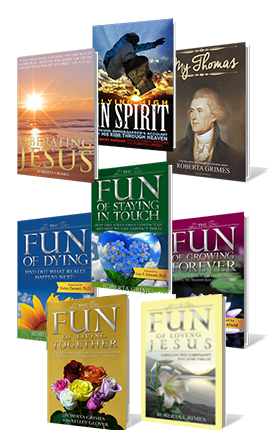
This year I have published seven books. Three are reissues of books in print, but four are newly out this year. It seems an medium_2934189215(1)insane achievement, like the time when I was terrified of heights but still I climbed on an open staircase to the top of St. Paul’s Cathedral dome. I really loved St. Paul’s Cathedral! And who knew when I might make it back to London?
To share with you the joy of knowing that, as with climbing St. Paul’s Cathedral, never again will I feel the need to do something quite so flat-out silly as publishing seven books in twelve months, we have enrolled all my books in Amazon’s Matchbook program. If you ever buy an Amazon copy of any of my books, you can then or later buy the Kindle version of that book for only ninety-nine cents. You might give the paper book as a gift and keep the Kindle version for yourself.

To help you decide whether any of my books is for you, I am going to blog about them. I apologize for this interruption. Next week we’ll return to using what we’re learning from the dead to try to fix the world. Promise!

NONFICTION

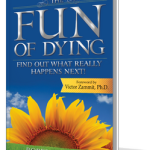
The Fun of Dying – Find Out What Really Happens Next was first published in 2010. It just has been reissued with fun-of-dying-3dcoverupdated appendices and a wonderful Foreword by Victor Zammit, the great afterlife researcher who is one of my heroes. We have nearly 200 years of abundant and consistent communications from people we used to think were dead, and when combined with insights from quantum physics and from cutting-edge consciousness research, these communications give us a breathtaking picture of the glorious reality that we enter at death. But even beyond coming to understand death, we are learning so much more! What afterlife researchers have discovered is a whole new branch of science, a third wave of physics that is consciousness-based. We are learning things about human nature, the nature of God, and the nature of reality that are surprising and beyond-belief wonderful.
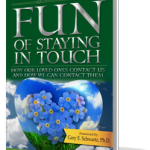
The Fun of Staying in Touch came out this summer. It details some amazing ways that the dead give us signs of their survival, fun-of-staying-3dcoverand also the many methods we have for contacting the dead proactively, including some just being developed that are going to make it impossible for anyone to still insist the dead do not survive. This book’s Foreword is by Gary E. Schwartz, Ph.D., of the University of Arizona at Tucson, who has done more than anyone else alive to prove that the dead are in communication with us.

MAINSTREAM FICTION

My Thomas was first published by Doubleday in 1993. It is a meticulously-researched mythomas-3dcoverre-recreation of Martha Jefferson’s journal. Conveniently, Thomas Jefferson’s marriage spanned the Revolutionary War, so My Thomas gives us a close perspective on the formative years of the United States from the perspective of a participant who was married to the author of the Declaration of Independence. This is one of history’s great true love stories! After Martha’s death, the evidence is strong that Thomas never married nor even loved again. He went on to become the first Secretary of State, the second Vice President, and the third President of the United States, but all of that was by his own account a consolation life. Forty years after his cherished wife’s death, Thomas Jefferson still referred to that decade of Revolutionary chaos and war as “ten years of unchequered happiness.”

Rich and Famous is an early-eighties coming-of-age story first published as Almost Perfect by Berkley in the early nineties. At its richandfamous-3dcovercore is the success of a woman from disadvantaged circumstances who by dint of pure determination builds such a successful business that she is a multimillionaire before the age of thirty. And this was back before the high-tech boom: her business delivers gourmet meals! Kim’s love story is a complicated one. There is a lot more going on than moonlight and roses. But like all my novels, this is a love story. People have been asking me to write a sequel because they want to see more of Kim Bonner’s happily ever after!

LETTERS FROM LOVE

Letter from Freedom, Letter from Money, and Letter from Wonder are the first trilogy of a seven-novel series. The only character that appears in all seven novels is Atlantica, an island in the South Atlantic where human life has FreeGiveawayThevolved to perfection. This trilogy spans almost forty years of the life of a man named by Time magazine the richest American under the age of forty when he was twenty-six. He owns Atlantica, but it is his star-crossed lover who becomes obsessed with the island, and then their son who helps us understand it. Although this trilogy tells a single story, all the Letter novels are independent of one another. They can be read in any order.

These novels grew out of the fact that what we learn from the afterlife evidence about human nature is stunningly different from what we always have assumed was true. We think of human beings as nasty brutes, Biblically fallen and requiring all the restraints of civilization to keep us from descending into bloody chaos and destroying one another. But the afterlife evidence indicates that each human mind is inextricably part of the perfectly loving and infinitely creative Mind that continuously brings forth the universe. In other words, each of us is part of God. Including Charles Manson. Including Adolph Hitler. But if our minds are at their base pure and letter-from-money-3dcoverloving, then how can so much evil exist?

I began to think about this question in 1977, when I was housebound with a baby and fresh from the discouraging tumult of the nineteen-sixties. Already I could see that the religious and secular view of human beings as inherently sinful and in need of restraint was turning out to be inconsistent with what we were learning from the afterlife evidence.

 So I began a thought-experiment. Of course, working scientists do thought-experiments. The notion is not inherently mad! We take a set of known parameters and vary some of them and see how that changes things. My thought-experiment was to place people in a culture in which freedom of mind was paramount. The only thing forbidden was laws or rules or anything whatsoever that imposed the smallest restriction upon the human mind. The result was Atlantica. And what amazed me as I observed the Atlanticans going about their lives was that so long as I didn’t play God and interfere, they worked out how to live in freedom. And their culture became amazingly letter-from-wonder-3dcoverstable. The process was fascinating to watch.


What surprised me most was the fact that the people in my experimental world became more and more sensitive to one another. That being perfectly free from coercion might make them more tolerant and kinder made sense, when I thought about it. But that soon they were reading energies and becoming aware of one another’s emotions did not. But then I thought about the fact that civilization itself could be the problem. All its rules might be inhibiting the full development of our mental powers, which evidence suggests must be inherently God-like. If governments and religions are making all the wrong assumptions about human nature, then effectively their rules and restraints are placing humankind in a cage that distorts our nature in ways that might be CREATING problems rather than SOLVING them.

I have come to believe this is in fact happening, based upon all the evidence. And further proof of its truth is the certainty that after ten thousand years of trying, governments and religions have done nothing whatsoever to improve our minds. In fact, when you remove the tech veneer, people might be more barbarous than ever. But if civilization doesn’t work in advancing human nature, then what might work? That is the question that the Letters From Love Series is asking, and is beginning to answer.

I am grateful to you for reading my books and sharing with me your own journey toward a greater understanding of our one reality. Hold onto your hat. Exploring the truth is an exciting ride!

No Fear

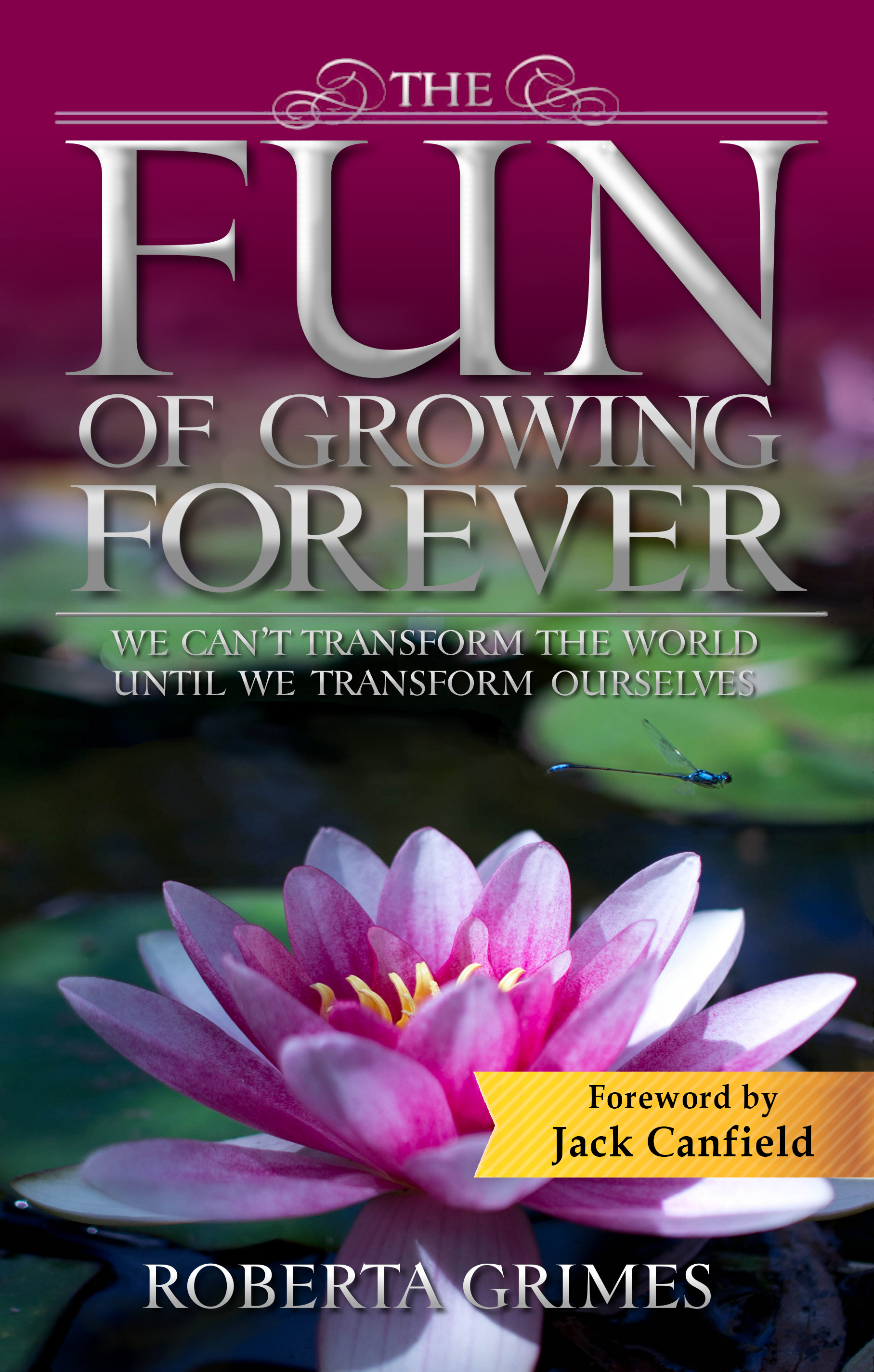
There are many glorious fruits to come from finally understanding what we are, but to my mind the greatest benefit is that it frees you from fear altogether. No Fear

Fear is pervasive in the modern world. We fear natural disasters and terrorism, cancer and accidents and nuclear war, alien invasions, our loved ones’ deaths, job loss, ebola, and simultaneously global warming and an overdue ice age. Apparently billionaire Elon Musk even fears the advent of killer robots.

The Armageddon that Mr. Musk fears would be brought on by artificial intelligence run amok. As he is quoted in the Washington Post article linked above:

The leading AI companies have taken great steps to ensure safety. They recognize the danger, but believe that they can shape and control the digital superintelligences and prevent bad ones from escaping into the Internet. That remains to be seen… This is not a case of crying wolf about something I don’t understand. I am not alone in thinking we should be worried.”

It seems that to be human is to be afraid.

I remember fear. I feared the dark to the point where for years I needed a nightlight in order to sleep. I had a crippling fear of heights. I recall what it felt like to fear death as extinction, or – even worse – as a lottery in which to choose the wrong Christian denomination could put you on an escalator down, no matter how well you had lived your life.

So I recall fear. What I don’t recall with precision now is the moment when all my fears disappeared. I simply noticed one day perhaps a decade ago that I was sitting in my darkened office with my computer screen the only source of light, and I didn’t mind it. Not at all! I realized then that it had been awhile since I had felt the need to turn on a light. There was nothing in the darkness that could harm me.

Initially my loss of fear felt amusing. The fear reaction that for all my life had been normal when I had faced any threat – whether something so general as a nuclear war, or something so specific as a medical scare or a close call in a car – simply was not happening anymore. As I meet others who have studied the afterlife, I am coming to realize that this utter absence of fear is a byproduct of learning the truth.

I have been trying to understand why this should be. Here is what I am coming to think:

  • Reality is safe and loving. What used to bother me about the dark was that I had no idea what negative entities might exist, nor what yawning maw of endless horrors might be lurking in the dark. I know now that at the base of all reality is the most intense possible love.
  • Each of us lives our lives in a structure that is carefully planned. Not only do we plan our lives, and especially we plan whatever negative experiences befall us as spiritual lessons, but each of us has guides and angels to assist us though our life experiences. Far from being a Wild West free-for-all, each human life is more like a carefully-structured day in preschool.
  • Fear of death is the base fear. On a primitive level, when you don’t fear death you lose that fear-trigger in your mind No Fear Jumperthat other things can activate. Oddly, this seems to be true even of nonphysical fears, like social embarrassment or the loss of a job.
           Freedom from fear is a joyous thing! The peace of living your daily life without all that garbage of fears in your mind is yet another reason why studying the afterlife evidence until your belief reaches certainty is worth every bit of your time and effort.

When you understand that your life is eternal and you are infinitely loved, it becomes hard to remember even what fear was like. What is the worst that can happen? Well, you might die. School might let you out a little early.


photo credit: <a href=”https://www.flickr.com/photos/69187071@N02/12281885336/”>Adrian Fallace Design & Photography</a> via <a href=”http://photopin.com”>photopin</a> <a href=”http://creativecommons.org/licenses/by-nd/2.0/”>cc</a>
photo credit: <a href=”https://www.flickr.com/photos/69187071@N02/12281378345/”>Adrian Fallace Design & Photography</a> via <a href=”http://photopin.com”>photopin</a> <a href=”http://creativecommons.org/licenses/by-nd/2.0/”>cc</a>

Un-Consciousness

To watch mainstream scientists flounder in their attempts to understand human consciousness used to be pass-the-popcorn time. You could see that they were missing the Big Picture, but you figured that if they took sufficient origin_4290962747wrong turns eventually they would stumble upon the truth. Law of averages. Just made sense. They couldn’t insistent on being wrong forever.

Or could they?

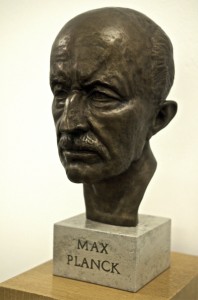
What we think of as human consciousness is primary and pre-existing. It predates the universe. It is part of the Source energy that keeps the universe continuously in existence. Max Planck, who is among the greatest physicists of all time, won the 1918 Nobel Prize in Physics as the father of quantum theory, but Planck better deserved a Nobel Prize for what is humankind’s greatest discovery. In 1931 he said, ”I regard consciousness as fundamental. I regard matter as derivative from consciousness. We cannot get behind consciousness. Everything that we talk about, everything that we regard as existing, postulates consciousness.”

Robert Lanza has been called the third most important scientist alive by no less an authority than The New York Times. In 2009 Lanza followed up on Max Planck’s pioneering insight by expounding his theory of Biocentrism, the notion that “life and consciousness are the keys to understanding the true nature of the universe.” His should have been a transformative book! But biocentrism still has not appealed to mainstream scientists sufficiently to shift their ongoing floundering in a more constructive direction.

Scientists are experimenting, too, with communication by mind, which they sometimes naively call “brain-to-brain communication.” For example, experimenters have succeeded repeatedly in having one person’s mind direct the movements of another person’s body. Surely some of these researchers must be scratching their heads and thinking that if this experiment works so well, then how on earth is it possible that human consciousness is confined to the brain?

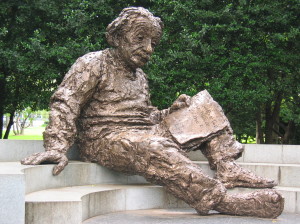
Einstein          So it begins to appear that scientists have begun to stumble in the right direction, which makes it discouraging to read Scientific American’s Ten Big Ideas in Ten Years of Brain Science and find that not a single Big Idea comes anywhere close to the possibility that the brain does not generate the mind. If it is even potentially true that human consciousness predates the universe and our brains only receive it, then that would be the biggest of big brain-related ideas, it seems to me!

           Instead of eagerly investigating the leading theories of our greatest scientific minds, most mainstream scientists remain un-conscious about the true nature of human consciousness. This, despite Max Planck’s pioneering insight that is many decades old; despite the wonderful work of America’s third greatest living scientist; and even despite the fact that there is no evidence that human brains generate consciousness, and in fact there is a lot of evidence against this highly speculative theory (including the fact that the human genome has just been reduced to only 19,000 genes, nearly all of which genes predate even primates).

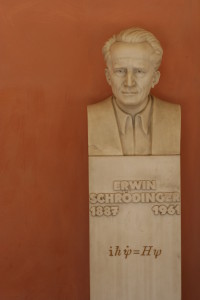
Max Planck is not the only prominent physicist to realize that the theory that human consciousness is primary and pre-exists the universe must follow inevitably from a better understanding of quantum mechanics. Physicist Euan Squires said, “Every interpretation of quantum mechanics involves consciousness.” Physicist, Astronomer and Mathematician Sir James Jeans said, “The Universe begins to look more like a great thought Erwin Schrodinger Sculpture In University of Vienna Courtyard -than like a great machine.” Physicist John Wheeler said, “A life-giving factor lies at the center of the whole machinery and design of the world.” And the great Erwin Schrodinger, winner of the 1933 Nobel Prize in Physics, said, “Multiplicity is only apparent, in truth, there is only one mind… ” “Quantum physics thus reveals a basic oneness of the universe.” Every quantum physicist with a free and creative mind must have had this notion as at least a passing thought!
Let’s give our last word to the immortal Max Planck, who one day soon will be seen as the grandfather of a consciousness theory of everything. In 1944 he said, “All matter originates and exists only by virtue of a force which brings the particle of an atom to vibration and holds this most minute solar system of the atom together. We must assume behind this force the existence of a conscious and intelligent Mind. This Mind is the matrix of all matter.”

photo credit: <a href=”http://www.flickr.com/photos/dustpuppy72/4290962747/”>Dustpuppy72</a> via <a href=”http://photopin.com”>photopin</a> <a href=”http://creativecommons.org/licenses/by-nc-nd/2.0/”>cc</a>
photo credit: <a href=”https://www.flickr.com/photos/fischerfotos/7408813732/”>Mark Fischer</a> via <a href=”http://photopin.com”>photopin</a> <a href=”http://creativecommons.org/licenses/by-sa/2.0/”>cc</a>
photo credit: <a href=”https://www.flickr.com/photos/hypermodern/7437395904/”>hypermodern</a> via <a href=”http://photopin.com”>photopin</a> <a href=”http://creativecommons.org/licenses/by/2.0/”>cc</a>

The Atypical Blanquito

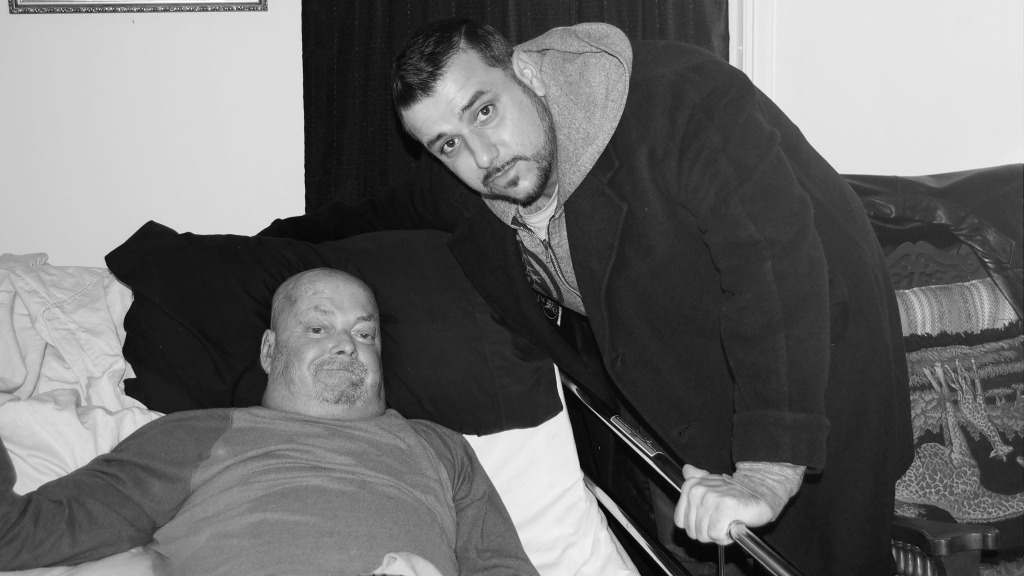
Two weeks ago I had a wonderful time with Bobby Pickles and his sidekick, Matthew Piazza, doing an interview in freezing weather in a nineteenth-century graveyard near my childhood home.  It was so cold! But I loved being there with my two young friends. And when Bobby told me about his devoted care of his dying father, I invited him to share his thoughts here with you. Take it away, Bobby!

There has been a considerable amount of death in my family over recent years. First, my uncle Billy found a spot on his lung; next, my uncle Ricky turned yellow with jaundice to discover he had stage-4 cancer of his pancreas; today, my own father (the brother of my two departed uncles) slowly succumbs to glioblastoma multiforme (the most aggressive form of brain cancer). Three uncles by blood. Three types of cancer. Genetically, I hit the cancer lottery. So, naturally, my recent family medical history has inspired me to come to terms with the reality of death.

Earlier this year, I took a step back from the hustle and bustle of big city life and moved out to the suburbs in order to care for my dying father. I never realized until now how as Americans we shield ourselves entirely from the the process of dying. We refuse to accept our own mortalities. We shop for our food at the grocery store, never having set foot in a slaughterhouse. Gone are the days of the hunter-gatherer. And we can go an entire lifetime without truly experiencing death. But if we do experience it, we experience it in this weird, assembly line style chain of events where the sick person is treated as a commodity to be dismantled piece by piece through the bureaucratic criminality of the doctor/hospital-insurance company-pharmaceutical industry paradigm. We go from hospital to nursing home to hospice to grave or urn. And when we die, we’re dressed up to look like marionettes. Our blood is replaced with chemicals to slow the decaying process. And then they bury that stiff sack of chemicals, which is us, in the earth. And if we are cremated, no one actually views our cremation. So, your ashes could be either you or a few dozen packs of cigarettes.

I have frequent discussions about everything from race to religion to politics with a Mexican friend of mine named Mike who once said, “Blanquitos don’t take care of their parents when they get old – they just throw them into nursing homes.” It’s a complete and total generalization, nothing more than a stereotype, but I believe it to be accurate. We damned white bred “blanquitos”! We must stop disassociating ourselves completely as death unfolds. We mustn’t ship our loved ones off to expire in some godforsaken institution. We should bring our relatives home where they can cross that great divide surrounded by the warmth and admiration of their family. And stop making excuses for why you can’t. That heartless corporation for which you work cares nothing about the welfare of you or your family. And in the end, you won’t recall the project you were working on while your family member was dying, you’ll just remember that you weren’t there for them. You miss out, they miss out, and then you become them. So ultimately we all miss out on our opportunity to make the dying process fun. Which it can be. Believe it or not.

“Dying is a part of life.” I know that’s cliche but it’s true. The process of dying is the counterpart of being born. And just as nine months of pregnancy can be a rich experience, so too can death. It’s a time to talk and learn and share and bond. It’s a time to forgive. It’s a time to have compassion. It’s a time to grow and to reconcile and to live. And let go.

It’s a time of enlightenment.

– Bobby Pickles is Founder/CEO at FAT ENZO and the host of Bobby Pickles’ Podcast.

unknown


Let Them Die

A recent article entitled Scientifically, What is the Worst Way to Die? reviews some of the most horrendous forms of death by Old Mantorture ever devised. Then it concludes that when every aspect is considered, including the intensity and duration of the pain inflicted and the degree of psychological suffering, the very worst possible way to die is the way that most of us will die. It notes that today “the leading causes of death are heart disease and cancer, which together accounted for 63 percent of all deaths in the US in 2011. People with these and many other diseases often live longer than their ancestors, but those final increments of life are more drawn-out and painful.”

And this news it even worse than it seems, since people who die in pain as the result of an acute event tell us they were out of their bodies during the process. Those who have died in auto crashes, for example, talk about having watched their fatal accidents from above or from the roadside. So it is likely that those being hanged, drawn and quartered also were safely out of their bodies. But our elderly loved ones too often have inflicted upon them years of suffering in the delusion that even such a damaged life is better than the alternative. It is not! The least that those we love deserve is comfortable and peaceful deaths.

My father had a stroke when he was 86. He was blinded and paralyzed on his right side. I sat by his hospital bed for most of a day and then the whole night through to comfort him and to prevent the insertion of tubes, the repeated removals for assessments and tests, the tying him down when he was restless, and all the other pointless stresses that modern medical care demands.

Dad came home by ambulance the next morning. His body had been in constant motion, but the moment he passed through his own front door he was at peace. During the two weeks that he survived, there never was a moment when Dad didn’t have his wife or a daughter by his side. Many friends visited him, announcing who they were and talking loudly, and Dad would smile when he heard their voices. His last two weeks on earth became a celebration. I hold forever in my heart one night when I began to read from the Book of Psalms to help him fall asleep, and each time I would stop reading he would open his eyes. I read Psalms to him that whole night through, choosing the beautiful and uplifting ones, until at last he fell Old Womanasleep as the dawn was breaking.

Could my father have had a few more years of life on this side of the veil? No doubt. Would he ever again have been happy here? No. To bring him home was my mother’s decision. It was one that his clueless doctors resisted. Twenty years later, I see even more clearly what a loving gift her decision was.

Your parents are going to die before you do. Letting them go is likely to be tough. So please resolve now that those you love will not die in protracted pain and fear, alone or in the care of strangers. Prolonging the suffering of an elderly parent will not change the outcome. Instead, release that weary caterpillar to become a joyous butterfly!

photo credit: <a href=”https://www.flickr.com/photos/oneworldgallery/4718065045/”>daystar297</a> via <a href=”http://photopin.com”>photopin</a> <a href=”http://creativecommons.org/licenses/by/2.0/”>cc</a>
photo credit: <a href=”https://www.flickr.com/photos/levycarneiro/3960791644/”>Levy Carneiro Jr</a> via <a href=”http://photopin.com”>photopin</a> <a href=”http://creativecommons.org/licenses/by-nc/2.0/”>cc</a>

Capital Punishment

One thing about doing afterlife research and better understanding our greater reality is that what you learn helps you to origin_2772052540establish evidence-based opinions on a great many things. At one time, I had little concern about capital punishment. So long as we executed only the guilty, what was the harm? To read of the despicable crimes that some of these criminals had committed made you feel almost as if the government were doing little more than eliminating vermin.

I know better now. Sadly, though, since most of our society remains clueless about how reality works, those responsible for carrying out executions have no way to understand all the harm they are doing! Here are some reasons why executing criminals never is a good idea, no matter how humanely it can be done:

  • It is impossible to kill a human mind. Our minds are eternal, and that includes the minds of the most notorious criminals. Eternal. You can execute their bodies, but their minds go on forever.
  • A mind freed from the body by death may or may not transition to the afterlife. There is considerable evidence that we have the choice of whether to stay or go, and evidence as well that people fearing judgment for things they may have done in life often decide not to make the trip.
  • A mind that stays behind maintains the emotional state that it had at death. We see this problem with men killed in wars. They may jump into a nearby soldier in the heat of battle and possess the mind of that veteran for decades. And they retain the same fighting rage that they had at their moment of death, which seems to be a common cause of Post-Traumatic Stress Disorder (PTSD) among veterans. Research has shown that sometimes merely coaxing out every possessing dead soldier can cure a veteran of PTSD on the spot.
  • The minds of earthbound entities are readily able to occupy the minds of the living. People in their prime have a natural energetic barrier that limits this possibility, but the very young and the very old and those who are drunk or high on drugs often have energetic protections so deficient that for spirits to possess them is easy.

 So, to recap, execution frees a mind that is inclined toward evil when it is at the height of fear and rage, and then enables it to roam and perhaps possess an innocent’s unsuspecting mind. Boy, talk about pollution! There is no more horrendous pollution than the freeing of a mind that is bent toward evil.

It is important, too, as loving fellow eternal beings to look at capital punishment from the viewpoint of the one being executed. I have a photo taken in the 1930s of a very young African-American man being strapped into an electric origin_8897427649(1)chair. Hovering busily, getting him attached to the mechanism that will end his life, are four middle-aged guys who are dwarfed by the robust health and the sheer charisma of the man who is about to die. What gets you is his face. He looks like your son or mine in the principal’s office, close to tears and gazing off into the distance, pretending to be anywhere else. I want to hug and comfort him. Even if I didn’t know how harmful it is to free criminal minds, that one photo would be enough to turn me adamantly against capital punishment.

Executing criminals is more expensive than incarcerating them. It causes incalculable spiritual harm. And it cheapens what evidence tells us is the most important thing there is: an infinitely precious human life.

photo credit: <a href=”https://www.flickr.com/photos/matthigh/2772052540/”>mlhradio</a> via <a href=”http://photopin.com”>photopin</a> <a href=”http://creativecommons.org/licenses/by-nc/2.0/”>cc</a>

photo credit: <a href=”https://www.flickr.com/photos/57412095@N05/8897427649/”>ArturoYee</a> via <a href=”http://photopin.com”>photopin</a> <a href=”http://creativecommons.org/licenses/by/2.0/”>cc</a>


Sex in the Afterlife

One of the questions I am asked when I speak about The Fun of Dying and The Fun of Staying in Touch is origin_5928977629whether we can have post-death sex. After all, the whole area of sexual relations is so important to our earthly lives. Isn’t it central to who we are?

       I think it’s important to consider why physical sex is so important to us. There seem to be three reasons:

1)    Procreation. Our bodies are driven to reproduce themselves. Hormones meant to get that done are powerful drivers of our interest in sex.

2)    Pair-Bonding. The human emotional urge to be close to another human being is strong, and sexual relations are a way to express and fulfill that need.

3)    Enjoyment. Physical sex is for many of us the most pleasurable thing that we do in our lives.

Do these reasons why we want to have sexual relations change in the afterlife? Based upon what the dead tell us, all three reasons disappear:

1)    Our post-death bodies lack a procreative drive. Probably because we don’t reproduce there, the dead tell us that their bodies have no physical urge toward sex at all.

2)    Fewer of us pair off, but instead we feel close to many people. We live in the afterlife without any of the hardscrabble maintenance needs that make pairing off seem to be a useful defense against a hostile world. Pair-bonds, if they exist at all, are generally looser and more companionate.

3)    For most of us, everything we do in the afterlife is pleasurable. We have no need to work, eat, sleep, or indeed do anything that we don’t feel like doing. We are young and healthy and surrounded by endless possible entertainments. And whenever we like, we can engage in an intensely pleasurable body-melding activity with anyone at all. The dead tell us body-melding is better than sex. And it has no morality attached to it.

So apparently, in the afterlife people really don’t bother with physical sex. Even for my dear friend Mikey Morgan, who died at the hormonal age of twenty, post-death sex holds no interest at all. But can we have sex there if we want it? It seems from the evidence that indeed we can.

There is a story told of a youth who had suffered a genital injury before he was killed in the First World War. His post-death body was created by his mind, and it still bore the injury that obsessed and depressed him. Even after corrective post-death surgery, he still thought himself to be less a man, so he was tucked into bed and put to sleep. He awakened to find a beautiful young woman in bed with him who initiated lovemaking, and he discovered that everything worked just fine!

I love that story because it so completely typifies the way the newly-dead are treated: whatever you might need to ease your recovery from the grievous ordeal that is life on earth, apparently they are eager to offer it. The personal care that each of us is given is shown in many such stories of tenderness toward the newly dead. But in all my origin_1045750850research, the rehabilitation of that genitally-injured soldier is the only account I ever have read of actual physical sex after death.

So apparently we have post-death bodies that are capable of having sex, but at the same time there are so many more enjoyable things to do that few of us bother with it. I don’t know about you, but the thought that everyday post-death life is better than sex seems to me to be a good thing!

photo credit: <a href=”https://www.flickr.com/photos/seanmolin/5928977629/”>Sean Molin Photography</a> via <a href=”http://photopin.com”>photopin</a> <a href=”http://creativecommons.org/licenses/by-nc-nd/2.0/”>cc</a>
photo credit: <a href=”https://www.flickr.com/photos/wtlphotos/1045750850/”>Wendy Longo photography</a> via <a href=”http://photopin.com”>photopin</a> <a href=”http://creativecommons.org/licenses/by-nd/2.0/”>cc</a>